




Ashley Kroese’s vehicular homicide trial in the death of Brentwood Police Officer Destin Legieza reconvened on Wednesday, giving jurors a more detailed look at the violent crash.
The day began with the testimony from two state troopers, one of whom led the crash reconstruction investigation and one who testified about the data recorded and recovered from the vehicles.
Among the new evidence submitted by the prosecution were dozens of photos from the scene of the crash and of the vehicles in a secured THP facility, showing extensive damage to the exterior and interior of both vehicles.
Legieza’s patrol SUV sustained the worst amount of damage, with the engine compartment crushed from the impact and pushed back into the driver’s compartment which pinned him in the vehicle.
One of the photos showed the crumpled interior of the patrol SUV, which shows the seatbelt, as well as the deployed airbag stained red with what appeared to be blood. One state trooper said Legieza wasn’t wearing his seatbelt at the time of the crash.
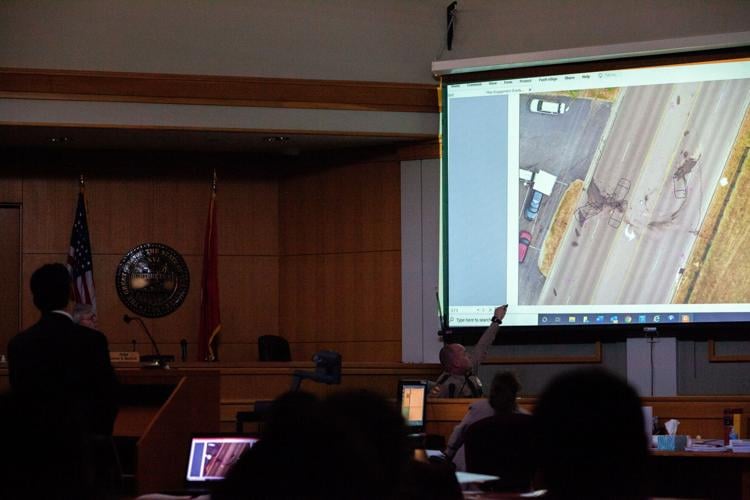
The crash occurred in the number one southbound lane of Franklin Road, meaning the interior lane closest to the center turning lane, with Legieza’s SUV recorded traveling at 52 mph and Kroese traveling at 58 mph at the time of the collision.
“The two cars had front-end damage to both driver’s sides,” THP Trooper Gerald Buchanan told the court. “So it’s an offset, head-on collision, so therefore they’re both going to rotate counter-clockwise. There was a fluid trail that showed the post-impact path that all lead to the number one lane.”
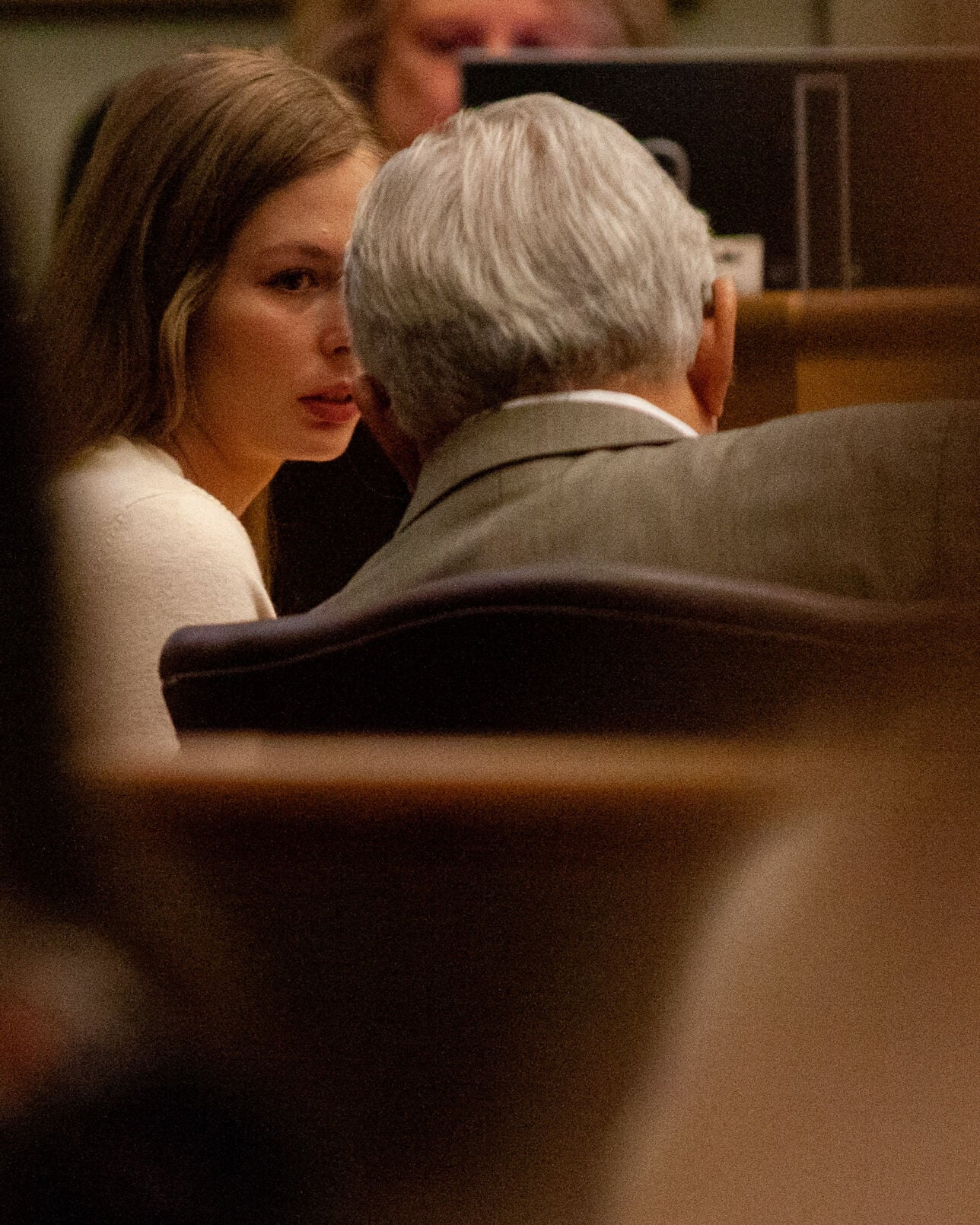
Defendant Ashley Kroese speaks with one of her attorneys, Lee Ofman.
The vehicle’s recorded data showed that Legieza never applied his brakes and suggests that he turned the steering wheel 0.2 seconds before the crash in a likely attempt to avoid the collision.
Being that the crash occurred just before sunrise and only his headlights were illuminated, he likely saw the oncoming Jeep in that fraction of a second before impact.
Kroese’s vehicle recorded that she was lightly riding her brake at the time of the crash, but it didn’t significantly change the severity of the impact, slowing down by only about 3 mph 2.2 seconds before impact.
According to Trooper Buchanan’s testimony, the ultimate cause of the crash was, “Ms. Kroese driving in the wrong lane of travel with no headlights.”
The prosecution also showed a photo of one of the Jeep’s headlight bulbs, which according to Buchanan’s testimony, showed no evidence of “hot shock,” a phenomenon that results in distortion or stretching of a bulb’s hot filament often seen during a crash when lights are on.
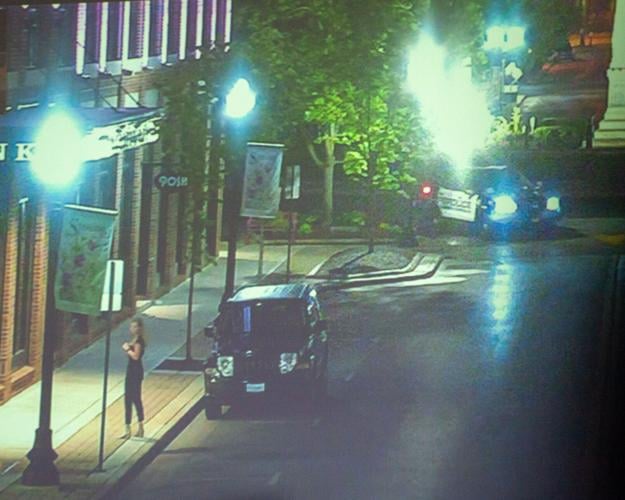
The jury was also shown new video clips from a previously-seen camera angle in Franklin, which depicted a woman identified as Kroese on the evening of June 17 and in the early morning hours of June 18, leaving and then returning to her Jeep which was parked just off the square.
Kroese is seen wearing a black romper (identified by one trooper as a “onesie-thing”) and high heels, and is seen being escorted to her car by a man, eventually driving away by herself at 4:38 a.m. with the Jeep’s headlights turned off.
The Jeep was also captured on a traffic camera nearby with its headlights off and stopped in the road for an extended time before continuing onto Franklin Road toward Brentwood.

Ashley Kroese is seen beside her Jeep Liberty just off the Franklin square in the early morning hours of June 18, 2020, prior to the fatal crash.
The man seen with Kroese, Max Jordan, current general manager and former bar manager of Kimbro’s Pickin’ Parlor, who is also the son of the bar’s owner, Will Jordan, also testified on Wednesday.
Jordan met Kroese, who is French, that night at Kimbro's, a night that he says he was off work for and just hanging out with “church friends.”
Kroese connected with Jordan over his “French-related tattoos,” asking him as they left the bar, “Hey French boy, can you walk me to my car?”
Jordan testified that he saw Kroese drinking a lite beer that night and described her state as “happy” and “social” but said that he only saw her drink one alcoholic beverage that night, and that she showed no signs of intoxication when they departed.
In April 2021, Kimbro’s Pickin’ Parlor settled a civil suit that was filed by lawyers representing Legieza’s widow, but that fact was quickly struck from the trial by Judge James G. Martin III, who instructed the jury to disregard the comment after Assistant District Attorney Carlin Hess asked Jordan about the lawsuit.
“You are instructed to disregard the comment, disregard the answer,” Judge Martin told the jury. “Put it out of your mind, and you may not consider it for any purpose in your deliberations.”
Wednesday also saw testimony by a former Kimbro’s bartender, who testified that she saw Kroese with at least three alcoholic beverages, one shot of liquor and two beers. Though, she said didn’t witness the actual consumption of all three of those drinks.
That former bartender testified that she was, in the prosecution's words, “personally concerned” with Kroese’s sobriety and ability to operate a motor vehicle on the night of the crash, and offered to call a car for her to get home.

Tennessee Highway Patrol State Trooper Gerald Buchanan testifies about how he investigated and reconstructed the crash that resulted in the death of Brentwood Police Officer Destin Legieza on June 18, 2020.
She also testified that Kroese consumed water and chips but was never formally cut off from alcohol by the staff, adding that she stayed at the bar after it closed with Kroese out of concern for her.
Several people stayed after hours at the busy bar, socializing on the front porch.
While the woman said that she was concerned, she never voiced that concern to anyone else outside of having an exchange with Jordan about “keeping an eye” on Kroese.
Another witness who testified actually served Kroese alcohol earlier in the evening of June 17 when Kroese and a friend first stopped in at Americana Taphouse. The server testified that, from around 7 p.m. to around 9:30 p.m., Kroese was served a 9 oz glass and a 6 oz glass of white wine and was sharing fries and a milkshake with her friend.
While she was Kroese’s server early in the evening, the two later connected at nearby O’ Be Joyful, where the witness bought Kroese a vieux carre whiskey cocktail and saw her drink another 6 oz glass of wine.
The group of now four people then met up again just after midnight at Kimbro’s where the witness bought Kroese a Jack and Coke, which she testifies she saw Kroese drink.
That witness' boyfriend also testified to seeing Kroese have the drinks throughout the night, but neither said that they noticed any kind of impairment with Kroese at the end of the night.
It's unclear if Kroese actually finished all of the drinks that she was seen consuming or if she had more to drink than what the witnesses testified to seeing themselves.
The day’s testimony ended with that of a Tennessee Bureau of Investigation Crime Lab Forensic Technician who received the hand-delivered blood-testing kit from a THP Trooper, as discussed on Tuesday, a manner of receiving it that the technician said wasn’t out of the ordinary for her.
The defense spent much of their time on the matter of the blood-testing kit and the samples that it contained, something that has been a focus of the legal defense team throughout the case’s pre-trial hearings.
The defense questioned the legitimacy of the blood sample, as well as the chain of custody in which it was delivered with it having been seized by THP by way of a warrant that was issued after Kroese's blood had already been drawn by the hospital for medical purposes.
An issue for the defense was most significantly a discrepancy between a vial of blood that was capped with a purple top but was labeled as having a “[light] green” cap, something that the TBI technician wasn’t able to definitely explain.
The technician noted that she handled and logged the samples as having the color tops (three blue and one purple) that she witnessed them having when she inspected the sealed kit as it was delivered by THP prior to delivering it to a sealed vault.
Most of the defense’s line of questioning didn’t actually lead to any insight on the discrepancy, but could potentially sow doubt in a juror's mind about the authenticity of the blood, which the witness confirmed was the actual sample she received.
Thursday will see continued testimony and may see the end of the trial’s arguments and jury deliberation.
Commented
Sorry, there are no recent results for popular commented articles.