
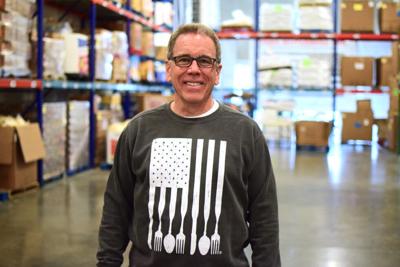

When the federal government shutdown caused a lapse in Supplemental Nutrition Assistance Program (SNAP) coverage earlier this year, Franklin nonprofit OneGenAway provided 5,000 food boxes to the surrounding community that week.
It was a huge uptick from the organization’s typical 10 to 20 18-pound nonperishable food deliveries per week, and that number has stayed at an elevated 100 per week in the month or so following. That’s on top of the additional boxes OneGenAway had been offering for furloughed government workers.
“The need was just tremendous, to say the least,” says Chris Whitney, founder and CEO of OneGenAway. “Our mission statement is ‘hope, honor and dignity shared through food,’ and we ask no qualifying questions. They didn't need to prove that they were on SNAP. They didn't need to do anything for us. We just give food away.”
OneGenAway is a one-trick pony, jokes Whitney. Since 2013, it has provided food to the Williamson County community and beyond. The food comes from a combination of donations, food the nonprofit buys and the 5 million pounds of food they rescued from grocery stores and event centers this year. With around 60 percent fresh produce and meats, the team delivers food six days per week directly to low-income neighborhoods. They also offer 38 drive-through pantries per year on Saturdays across Middle Tennessee and open the warehouse to any social workers who need food for their clients regularly. In addition, OneGenAway distributes weekly nonperishable pantry boxes in Williamson County, for which people sign up on Monday for a box to be delivered on Friday.
In all, OneGenAway distributed between 12 and 13 million pounds of food this year.
What started out of Whitney and his family’s Hyundai Santa Fe in 2013 is now a fleet of refrigerated semi trucks.
OneGenAway refuses any funding that requires the beneficiaries of the food provide identification or proof of income. However, Whitney says the food distribution is paired with one question — “Is there anything we can pray with you about today?”. That conversation can also include connecting people to other resources, like transportation or medical needs.
“I feel like people just need to know that somebody sees them,” he says. “We care about them. To me, the greatest joy about giving away food is that I get to look at our friends face-to-face. I get to look in their eyes and look at my eyes and say, ‘We are so glad we get to see you, glad to meet you, and thankful we get to be a part of your life right now.’ And I don't think there's any greater joy than that.”
Whitney knows what it’s like to need help from a food bank. He and his wife Elaine have a daughter with spina bifida, and during one six-month period, they found themselves in line for food charity due to medical costs.
“It's hard to get out of shame, but it's really easy to get in it, and it's really easy to heap more shame on,” he says. “We want to diffuse that.”
The sheer growth of OneGenAway proves there is a need in Williamson County, despite it being the wealthiest county in the state and one of the wealthiest in the country. Whitney points out that in the Franklin Special Schools District, 37 percent of students are on assisted lunch.
“There's this misnomer that because we live in this place, no one's hungry, no one has need, and that just couldn't be further from the truth,” he says.
The next issue on OneGenAway’s radar is the spike in health insurance premiums due to the expiration of tax credits. This means that many may forgo coverage and pay out of pocket and will need food assistance, he anticipates. With the help of a new partnership with Children’s Hunger Fund, the organization will be able to serve more people than ever before.
As Whitney puts it, what was once the organization’s ceiling is now its floor.
Whitney also wants to take the organization national. They have a warehouse in Decatur, Ala., and serve 41 counties. The next step is to serve all 95 Tennessee counties and expand to other states.
“It's amazing how the church and civic groups, when a disaster happens — a tornado, a flood, a hurricane — all of a sudden we could all get along,” he says. “Isn't it amazing? We all run together. Gosh, you're my brother, my sister. I'm so excited. I love that. I love that we do that. But there's a natural disaster that happens every day, and it's called hunger.”
Commented
Sorry, there are no recent results for popular commented articles.