
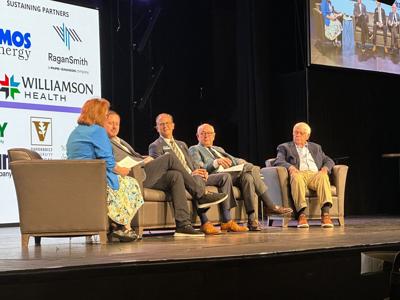
Franklin Tomorrow hosted its latest Breakfast with the Mayors on Tuesday, where local mayors discussed city projects, ongoing negotiations with state departments and how they plan to manage Middle Tennessee’s ongoing growth.
Participants included Williamson County Mayor Rogers Anderson and Franklin Mayor Ken Moore, as well as two recently elected local leaders: Brentwood Mayor Nelson Andrews and Spring Hill Mayor Matt Fitterer.
Anderson began the panel by recapping some of his remarks in his recent State of the County address. He spoke about a new proposal for legislation that would allow Tennessee counties to keep 50 percent of local real estate transfer taxes. He noted a petition by Williamson, Inc. supporting the measure, which has earned more than 10,000 signatures.
In Williamson County, it's estimated that the returned taxes would be $14 million annually, which Anderson said the county would like to dedicate at least half of for transportation improvements.
Anderson also spoke about the county’s credit rating, which is the highest possible credit rating according to Moody’s.
“With the Triple-A Moody [rating] in Franklin and Brentwood, we’re probably one of a few counties across the nation that’s got two cities and a county that are all Triple-A rated,” he said.
Moore shared updates on a Franklin delegation’s recent trip to its Sister City of County Laois, Ireland, where Moore and other city officials attended local government meetings and spoke with their Irish counterparts.
Andrews gave a brief recap of the Brentwood's recent election, noting historic voter turnout.
“I’m really glad to say that with this election we had this year, we had record turnout. Brentwood had roughly doubled the turnout of any previous election,” Andrews said.
Andrews also briefly updated attendees on the hiring of Brentwood’s new city manager, Jason Gage, as well as ongoing capital improvement projects on McEwen Drive and Ragsdale and Old Smyrna roads. He also promised attendees that the city is working on improving the currently spotty cell service on the east side of the city.
Andrews emphasized that he and the entire commission are excited to work alongside the county and other cities in the future.
“I feel like we’ve got a great spirit of collaboration on our commission,” Andrews said. “I feel like our commission has a much more outward focus in terms of collaborating, not just inside the city but with the county and our neighboring cities, and I’m really excited about where we’re headed.”
Fitterer joined Andrews in speaking about the hiring of a new city administrator (Larry Burks), who will join Spring Hill next month. He also gave updates on Spring Hill’s new police station, which opened in May, and previewed the city’s new fire station set to open in November.
Fitterer also explained that one of Spring Hill’s largest current obstacles is matching their sewer capacity to their growing population. Spring Hill is in the Duck River watershed. The mayor noted the Tennessee Department of Environment and Conservation encourages the city to be mindful of maintaining and preserving the water of the Duck River.
“[The watershed] has a lot of environmental challenges, and so [TDEC] is really sensitive about the amount of sewer treated effluent that’s discharged into the Duck River. Spring Hill’s been working since about 2018 to try to increase our sewer capacity. We unfortunately have not made as much progress as we needed to,” Fitterer said.
Spring Hill will likely place a moratorium on all new sewer lines and will soon begin construction of an Advanced Water Purification project. Under this new plan, sewage would be treated at a wastewater plant and then sent to a reservoir, where it is blended with water from the Duck River, and then sent back for treatment again. This method, known as water reclaim, significantly reduces the amount of water cities use and has a decreased environmental impact.
While this method has been used in other states and municipalities across the country, Spring Hill’s plant will be the first in Tennessee through a 12-month pilot program with TDEC.
“We’re piloting something that we believe, ultimately, is going to be a statewide solution. So you have less impairment on fresh water sources, and you’re able to make better use of the natural resources that already exist,” Fitterer said.
After each mayor concluded their updates, they were asked whether they see a growing sentiment against growth in their respective jurisdictions. Fitterer said that in Spring Hill, many citizens are those who have helped grow the city, and thus see the benefit of development.
“When I was first elected in 2015, I think our population was 27,000; we’re 65,000 now, so we’ve grown a little bit,” Fitterer said. “I think a lot of the people in Spring Hill are new, and they’re part of the growth. They understand that healthy things grow, so it’s a little bit more difficult for them to get upset at the very thing they’ve benefited from.”
Moore said he’s seen some negative sentiment surrounding new development in the Cool Springs area, and added that while he understands people’s fears about overdevelopment, he believes this development benefits most people.
“These [developments] are bringing jobs to people that live here, but also people’s children that want to move back here in the long run,” he said.
In concluding the panel, Anderson said that he believes growth is positive, but needs to be managed well. He pointed to the county’s educational impact fees as a way to manage growth without placing too heavy a burden on residents.
“I don’t think growth pays for itself,” Anderson said. “I think you have to build in fees to take that, and if somebody wants to come, like the county commission did several years ago and put an educational impact fee up, and if you want to come here, then you have to pay to catch up with what the rest of you have already paid for. And that model will be replicated as we go down the road — we’re learning as a community.”
Commented
Sorry, there are no recent results for popular commented articles.