
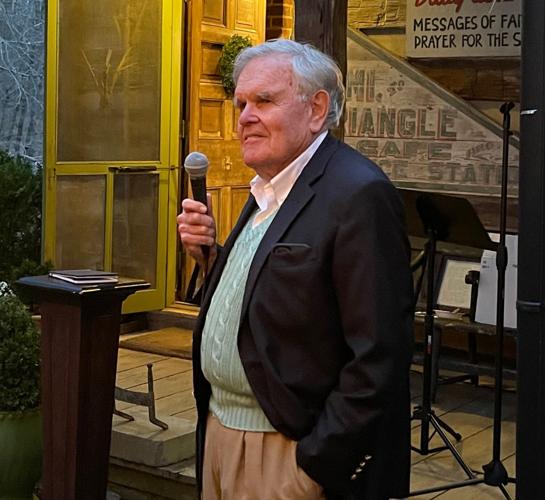
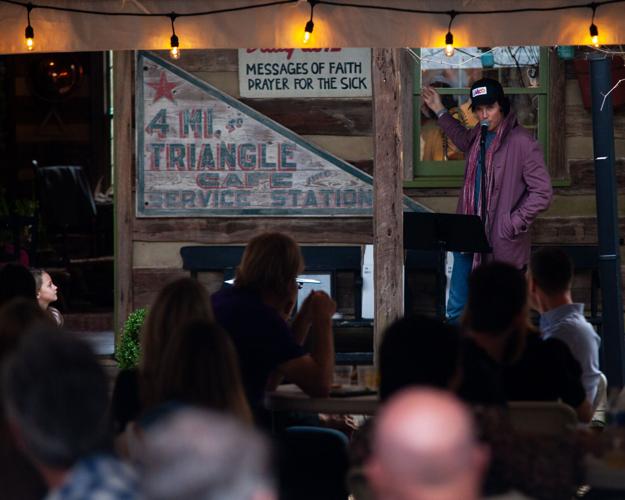
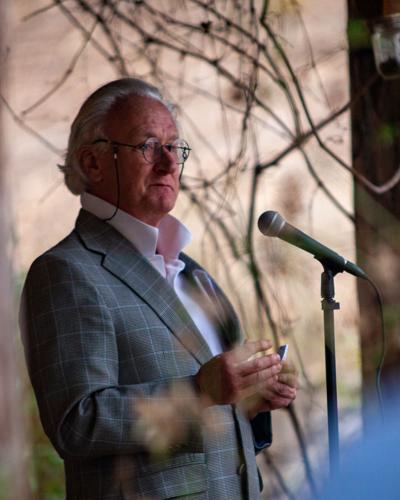


Adam Goodheart, historian and journalist who once featured the Battle of Franklin in an article on Civil War battlefield preservation for National Geographic, recalled a text he received from Franklin author Robert Hicks after a visit a few weeks ago.
Goodheart had traveled from his Washington, D.C., home to Franklin to join others in celebrating Hicks’ 71st birthday in January. As he was about an hour into his return home the next day, Goodheart saw his phone light up.
“It was a text from Robert,” Goodheart said, “and it read, ‘Adam, please know how much I love you. Thank you for being my friend.’ And if I were to ask for a show of hands here for how many people ever got a [similar] text or phone call from Robert, I bet just about everybody here would have.”
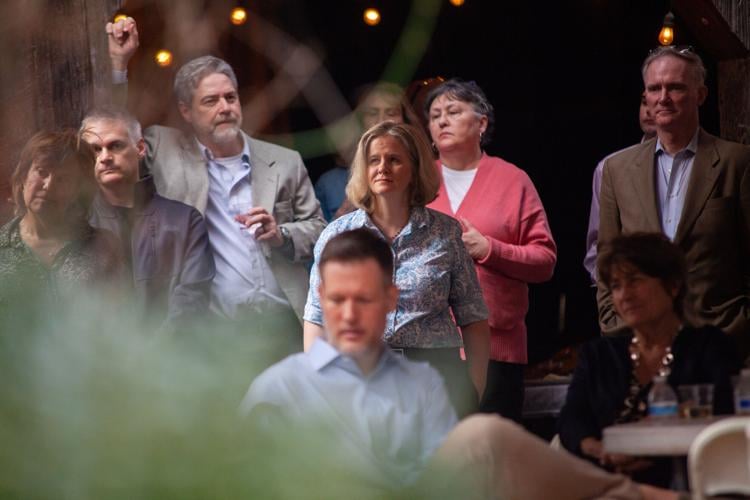
And sure enough, at least half of those who were in attendance at Saturday’s celebration of life for Hicks raised their hands. It was an acknowledgment of sorts for how many people were impacted by their friendship with Hicks, who died Feb. 25 after a lengthy bout with cancer.
There were tears mixed with smiles and even uproars of laughter as others joined Goodheart in speaking about Hicks at his “Labor of Vain” home in the hills of Bingham near Franklin.
Hicks, who was known for his 2005 bestselling novel The Widow of the South, his preservation efforts in Williamson County and beyond, and his abiding friendship with people from all walks of life, was laid to rest Sunday in a graveside service at the McGavock Family Cemetery at Carnton.
“I’ve known Robert since the late 1990s,” Franklin resident Tim Putnam, who knew Hicks through the music industry, said from the stage. “I don’t know many of you, which I think is a testament to who he was. We’re all tethered to Robert for many different reasons.”
Mindy Tate, executive director of Franklin Tomorrow, said her association with Hicks goes back to when his The Widow of the South was being published. She spent a good deal of time with him as a friend through the years, but she was particularly touched when asked to be by his side after his cancer diagnosis in 2018.
“We were great friends, and we spent a great deal of time together,” Tate said. “But when he became sick, I was drawn to be part of his care team, from being there the first night in the hospital and caring for him. Being part of the care team meant a lot to me, and I appreciate the time.”
Others got to know Hicks through their seeking information for various projects. Kim Hinton, a Nashville architect, first met Hicks when he had specific questions about the Civil War.
“I loved this man,” Hinton said, his voice breaking just a bit. “I’m going to miss him a lot. He was caring. He was generous. He was humble, and he was a great Tennessean.”
Nelson Eddy, Jack Daniel’s historian and a writer himself, formed a bond with Hicks through their mutual love of writing, of history and of storytelling. Eddy spoke to Hicks’ art of storytelling squared.
“Not only did Robert tell us all wonderful stories, he knew your story,” Eddy said. “He took the time to ask you questions and to learn all about you, and he knew your story. … The real story is that Robert knew your story and would tell it to a lot of folks.”
Rod Heller, part of the Harpeth Associates group that led the development of Harpeth Square in downtown Franklin, got to know Hicks through their shared interest and advocacy for preserving battlefields and other sites from the Battle of Franklin. Heller spoke to how impressed he was of Hicks’ “unique capacity to get things done.”
“The number of things Robert did in this community — not only in historic preservation but in the role he played in so many ways — I think needs to be recognized,” Heller added. “In the same way we love him, he has also left a tangible contribution to the culture and the spirit of Franklin that’s just remarkable.”
While many of the speakers and attendees at the celebration alluded to having known Hicks through a professional or historic preservation standpoint, Brad Spain’s association was a tad more organic.
He grew up over the ridge from the cabin where Hicks lived on Indian Valley Road. Spain got to know Hicks through an older cousin who went to school with him in Nashville, and they would often hang out in what was then considered land of mountain folk. Hicks got his “Southerness” quite honestly, Spain told the audience.
“At 18, he was fully formed,” Spain said, his double entendre filling the space with laughter. “He was totally Robert Hicks as all of y’all know him.
“A lot of us kind of come and go with ourselves and try to figure out who we are and what we’re all about and what we’re going to do. Some of us never even get there, but Robert was Robert right off the bat. He never changed.”
Commented
Sorry, there are no recent results for popular commented articles.