

While Williamson County opioid overdose deaths have hovered around the 40 per year mark — a number that is dwarfed by Davidson County’s roughly 100 per quarter — there is still a substantial demand for services in the county.
The Williamson County Opioid Task Force has distributed roughly $1 million per year in 2024 and 2025, with applications already submitted for a 2026 funding round.
More than $50 billion in opioid abatement funds is currently being distributed nationally, including millions in Tennessee. The money comes from lawsuits against companies charged with fueling the opioid epidemic, including CVS, Walgreens, Kroger and drug companies Purdue Pharma and Johnson & Johnson, among others.

Demetria Corlew
One of the local veterans in the space is Educare, which was founded in 1998 and has received two rounds of funding. The 2024 funding round of $150,000 covered costs for patients in the intensive outpatient program for juveniles, which had an extensive waitlist and was cost-prohibitive for many, says executive director Demetria Corlew. The $100,000 second round was used to expand its adult outpatient program, adding emphasis on cognitive behavioral therapy and motivation enhancement therapy. The organization is hopeful for a third round to add additional clinicians.
Educare does not take insurance, but it does offer grants that help pay for people who are uninsured or underinsured. Corlew says 95 percent of the clients have financial need, and the bulk of referrals come from the court system.
“That is oftentimes a common assumption, that there is not a financial need,” Corlew tells the Williamson Scene. “However, every single day, we receive phone calls from individuals themselves or family members looking for treatment resources.”
Corlew observes a growing number of individuals who are seeking treatment in the county. Many of them experience addiction following a post-surgery opioid prescription. Youth are becoming more commonly involved with opioids, too, whereas in the past the organization focused on alcohol and marijuana in teens, she says.

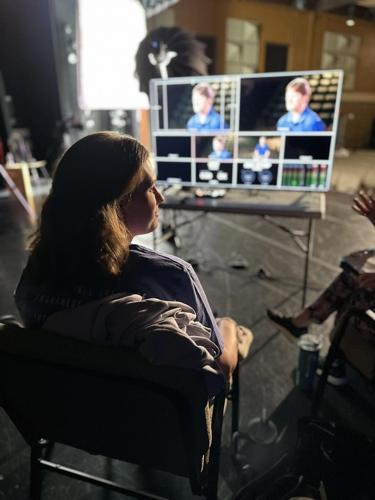
A behind-the-scenes shot of the filming of the "You Are Not Alone" series.
The Williamson Prevention Coalition has used its two-year, $100,000 opioid abatement grant to fund a video collection called “You Are Not Alone.”
The organization seeks to educate youth on making healthy choices, and help parents know how to talk to their child about drug use. Having not had much success in getting people to a gathering on the subject, they wanted to meet parents and students where they are — on their cell phones. The "You Are Not Alone" series is about breaking stigmas, Corlew says.
Actor Jason Waller (Laguna Beach, The Hills), who currently lives in Franklin, was one of the first interviews for the series. There are currently 34 testimonials including celebrities, public officials, city and county mayors, people with lived experience, people who lost family members, first responders and medical professionals. By the end of the year, it’ll be 70, says Lyndsey Wilhelm, executive director of Williamson Prevention Coalition.
“I think for a long time, it was a sheer lack of knowledge of how to have these conversations, and keeping up with all of the latest trends,” Wilhelm says. “We're really trying to make the feeling of being such a mountain to climb seem more like a small, little bump in the road.”
She added, “When I was younger, I felt like, if I asked about it, they're just going to assume that I'm doing it. We're really trying to help shift that mindset there, and I do feel it's changing in a very positive way.”
Williamson Prevention Coalition also provides a source of naloxone (through two regional overdose prevention specialists), connects people to treatment when needed, and offers drop-off locations to safely dispose of drugs.
A team at Middle Tennessee State University helps Williamson County providers apply for the abatement program, which involves breaking down a 15-page document detailing six approved strategies. For the 2025 funding, 11 out of 20 applicants received grants.
Sarah Gwinn, senior project coordinator for the Office of Prevention Science and Recovery at MTSU, notes that applicants may not include opioid overdose reversal drug naloxone in their grant applications because they can access free naloxone through their regional opioid prevention specialists. It’s up to the area organizations to bring forth pitches, and there are inevitably blind spots.
“If we don't have an agency or organization submit an application to do that work, that conversation is likely not going to come up,” Gwinn says.“ A lot of what our work also is educating the community, educating the board about how valuable some of these programs are and how effective they are in reducing overdose deaths. There's a lot of stigma involved with harm reduction.”
Gabrial Cathey with the Office of Prevention Science and Recovery Statewide Projects notes that, like the tobacco abatement funding of yore, opioid abatement funding is limited, and the goal is to produce projects that are impactful long term.
“Building really strong communities that have really good recovery-oriented, prevention-oriented practices on the front end will hopefully be stable to continue, even as funding sort of decreases from these lawsuit settlement dollars,” Cathey says. “That will hopefully be the long-term outcome here. When the money's gone, the money's gone, so all we can do is hopefully make sound funding recommendations for programs that will more than likely do well."
Commented
Sorry, there are no recent results for popular commented articles.