
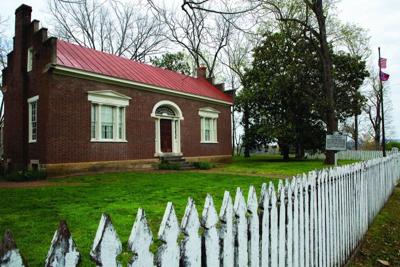

In 2009, when the Battle of Franklin Trust took over the historic site, the Carter House and CEO Eric Jacobson made a rule that topics of race and slavery could no longer be brushed aside.
The 250th anniversary of the signing of the Declaration of Independence this year is tied to the Revolutionary War, but it is inextricable from Civil War History, he says. After all, Williamson County residents of today are the same distance in history from the Civil War as Civil War players were from the Revolutionary War.
“The central theme of the Declaration is human equality, and we want to really challenge people when they come to a Civil War site or an antebellum site — we can't avoid slavery and race any longer; we have to talk about this,” Jacobson tells Williamson Scene.
When the new, $6.5 million Herbert Harper Visitor Center at the Carter House State Historic Site is set to open in August, the slave cabin will be moved so it’s the first thing people see when they exit. The center will also house an exhibit covering the period from the Declaration of Independence to the end of Reconstruction, 1776 to 1876. The Civil War was a major pivot point in the middle of that time period.
Jacobson lost a few employees due to the shift in curriculum he instituted. People had a romantic idea of the South, and focused more on the beauty of the land and buildings in the past, he says. He’s seen change during his 20 years working on Civil War historic sites.
Talking about slavery was taboo when he started, and romanticized. People even said things like, “It’s not that bad, the slaves loved their masters,” he says. “That's what people do. What's right in front of them is too hard to talk about, so they come up with a million excuses.”
Today, people increasingly want to know the truth about slavery and other atrocities and controversies of the era, he says. Plus, with a phone in your pocket, historic sites cannot so easily spin a tale. Jacobson sees an opportunity to engage more fully with guests across subjects, including the military campaign during the Battle of Franklin, which devastated the Confederate Army of Tennessee. Some visitors won’t come back, because it’s now too “woke” or “politically correct,” he says.
“It was so easy years ago to spin a romantic tale about the South and about America, about the Civil War,” he says. “I want people to understand the gravity of this place.”
The Carter family owned 28 people.
“The Carters owned people,” he says. “I don't have to and never would call them names. I'm not gonna say they were evil or racist. They were people of their time, but there were other people of their time who weren't doing that.”
Jacobson acknowledges that no one wants to come to a historic site to hear entirely doom and gloom, the ways in which the country and its people failed or hurt others. Even with the truth, there is still redemption in every story, he says.
“Who wants to visit a historic site and be told and lectured about how everything was awful and terrible in the 19th century, nothing's redeeming,” he says. “Well, there's redemption in all sorts of stories.”
The biggest redemption story? The fact that the United States is still a country today, 250 years later. He sees young people being curious, attentive, interested.
“I'm actually kind of pleased that maybe with the Civil War we're going to get to a point where instead of just hyper-focusing on every battle and every commander and every uber nerdy detail, we can talk about why the war was important, why the war, as an event, was important. That’s the future,” he says.
“I want history to be something that is alive. I don't want it to be stodgy and old. I want people to come here and be able to take a tour, and I encourage my staff to engage. There's no question off limits, nothing. We don't have the corporate, ‘we don't have a response to that.’ We go after everything.”
Commented
Sorry, there are no recent results for popular commented articles.