
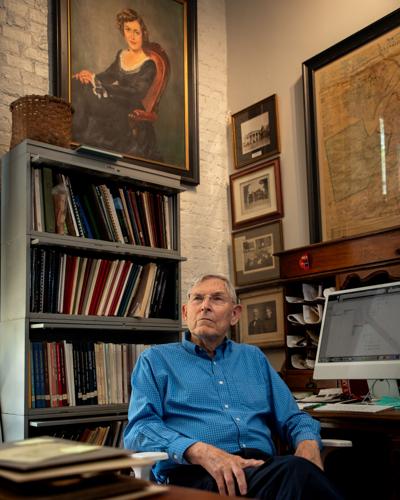


Williamson County Historian Rick Warwick poses for a portrait in his Franklin office, June 17, 2026.
Growing up, Williamson County Historian Rick Warwick was the kid who loved being the youngest person in the room. When he joined the Williamson County Historical Society in 1973, he and his wife were the youngest couple there. Today, they’re the oldest.
Warwick can now be found in his new office inside the Lehew Mansion in Franklin, which he calls “one of the best houses in the county.” He brought about a third of his materials there, with the rest in storage at the Williamson County Archives and Museum.
People most commonly request the history of their home, or sometimes, their own family. On the day Williamson Scene visited, Warwick was scanning pictures an area resident had donated from a loved one’s estate. His Flickr account now has more than 27,000 photos, which anyone can download freely.
When he’s not answering those calls, Warwick is working on a book — his 30th, or so he estimates. His latest book has a working title of Beyond Leiper’s Fork, and will include history on several small communities including Garrison, Boston, Parham, Bending Chestnut, Greenbrier and Craigfield. Warwick is incredibly collaborative, welcoming input, accounts and artifacts from area residents as he researches.
“I want them to see themselves in the book,” he says. “Sometimes there's people that live in that community that want a written history, they want to know who lived in my house or who owned my farm, and that's kind of been my little niche. Sometimes I know things that nobody else knows.”
Warwick’s goal stepping into the appointed role in 2017 was to ensure each community in Williamson County had a written history. He often references an 1878 civil district map of the county above his desk to chart his plans. After Beyond Leiper's Fork, he has another book on the former District 6 in the north part of the county nearly finished, which will include Bingham, Forest Home and Ash Grove.
In each of the books, Warwick highlights old families, schools, post offices, churches and other significant buildings. He’s taken side quests along the way, writing about chairs (made by formerly enslaved craftsman Dick Poynor, specifically) as well as the history of sugar chests, postcards and embroidery samples. Warwick is also one of the founders of the African American Heritage Society of Williamson County and has worked with co-founder Thelma Battle to pen several books on Black history.
It may be surprising to learn that Williamson County is Warwick’s adopted home. He grew up in Henderson County in East Tennessee and spent a lot of time with his grandmother as a child. When he was given free rein while his mother worked, he went to hang out with his cousins — who were 80 years old.
“They’d tell me stories because their dad was in the Civil War, or they all had stories about what happened,” he says. “We'd go to cemeteries. I always liked history. It really was the only good subject I had in school.”
He earned an undergraduate and graduate degree in history and library science at Middle Tennessee State University before moving to his wife’s home county of Williamson. His interest in Williamson County history grew from his seventh grade classroom at Hillsboro School in Leiper’s Fork where he thought the original textbook was “terrible.”
“I thought you needed to know about your community and your county and your state,” he says. “Then I started going out and learning. That's why I joined the Historic Society, and started reading up in their old journals and things like that.”
He also gave his students assignments to interview their oldest family members about history.
Williamson County has better documented history than its peers, thanks to Warwick and the fact that the historic courthouse never burned, like many did during the Civil War. Warwick himself used to read the entire Franklin Review-Appeal newspaper archives once per year.
“That takes a long time to go through hundreds of reels, and I would catch things that nobody else knew about,” he says. “If it happened here, we can usually find some information about it.”
At 79, he doesn’t see himself ever retiring completely. Brian Laster is his friend and “heir apparent,” however, and Warwick has already passed along the historical society's yearly journals and the responsibility of historical markers.
“I’ve got the fifth district lined up,” Warwick said of future projects. " You know, by that time I may be dead. I'm 79 and I ain't gonna be around forever.”
He might have more time than he thinks. His mother is 101 years old and still living near his hometown.
“I hope I've left a legacy,” he says. “I think I've done things that nobody else has done.”
Commented
Sorry, there are no recent results for popular commented articles.