
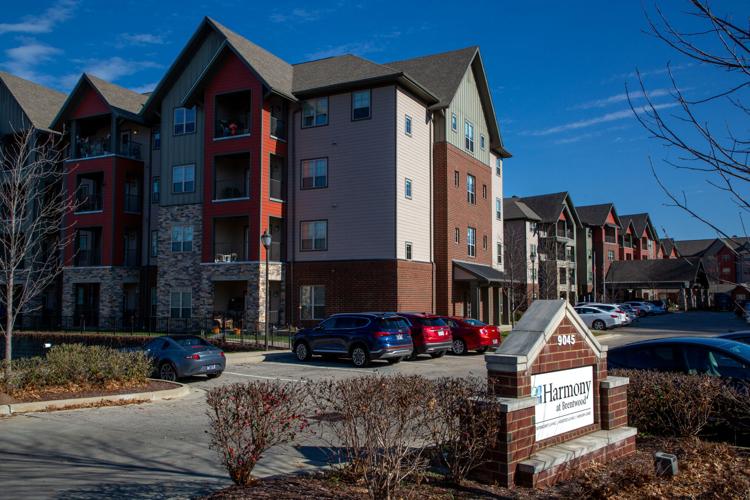


In the memory care unit at the Harmony at Brentwood retirement community, a group of residents rolled their wheelchairs and walkers around a television. They sat still and silent as they watched The Polar Express, some with reverence, others with disinterest. White-flecked garland and golden lights wrapped the columns that divide the common room into thirds. The room was quiet, except for the sound of the television and the soft lull of Christmas music.
Around the corner from the commons area, a woman of about seventy sat in a chair with a baby doll on her knee. She bounced it up and down, held it up to look at and spoke to it sweetly.
“You’re so pretty,” the woman says to the doll, turning to a Harmony staff member with a big grin. “She takes after her mother, don’t she?”
The woman’s name is Patricia or “Patsy” Carmack. She is a lighthearted, witty, energetic woman who smiles through her eyes and greets her friends in the hallway with warm exclamation.
Carmack has lived in the Harmony at Brentwood memory care unit since developing some of the more severe symptoms of dementia. Sometimes she cannot remember details of the past. Sometimes she forgets things she says five minutes prior and sometimes she slips from one idea into another, speaking in little strands of thoughts, one overlapping another. Though she may not always find the right word or name to fill out her stories, her cadence is rarely broken. The jokes she cracks are on time and she answers questions directly.
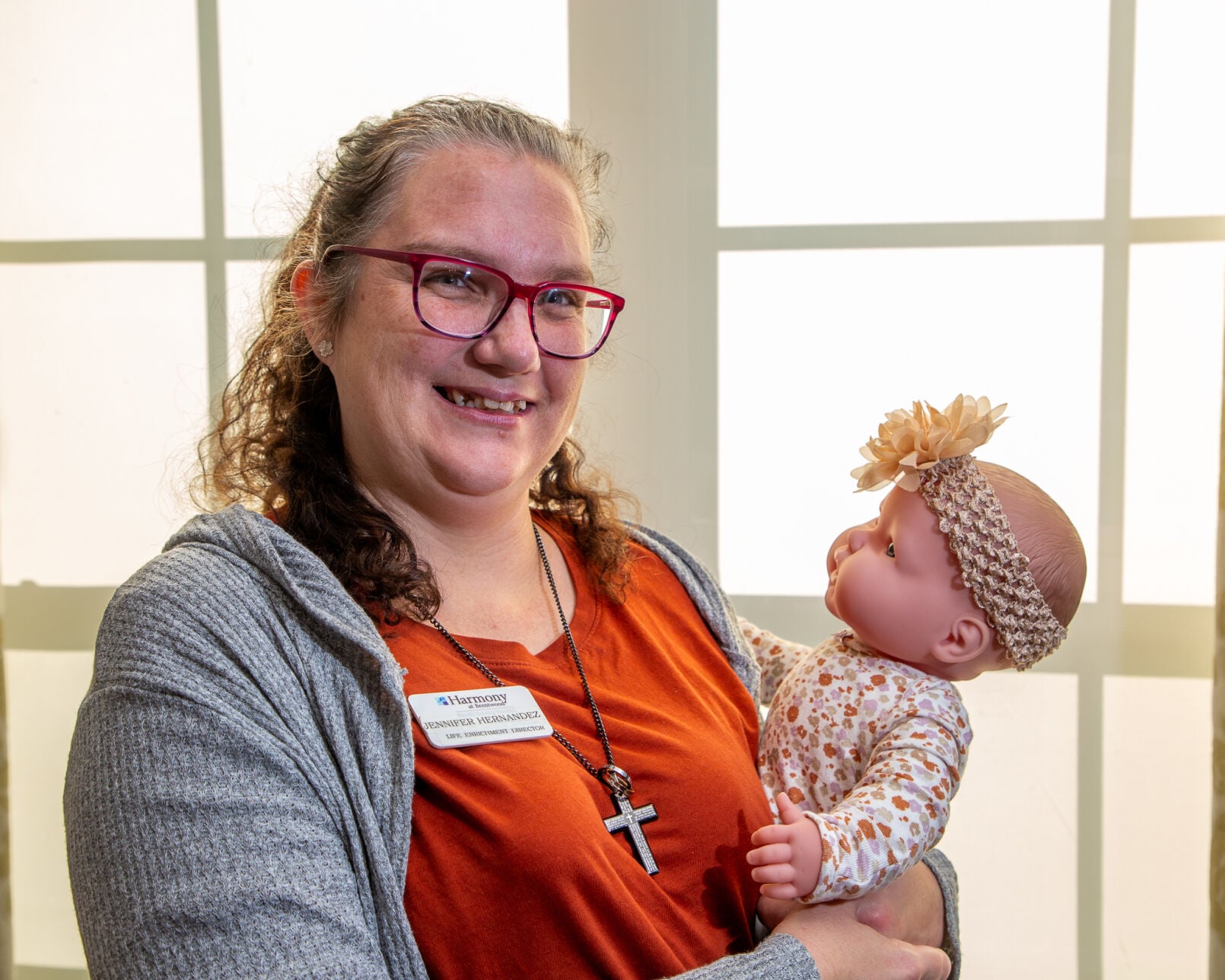
In late September, Harmony at Brentwood provided around 50 realistic-looking baby dolls to residents in their memory care unit. The dolls are part of an unconventional treatment for Alzheimer's and dementia – doll therapy – which has shown promising results in clinical trials. Studies from the National Library of Medicine and Nursing Reports show that doll therapy can have the effect of decreasing the behavioral and psychological symptoms of dementia, such as improving the patient’s mood, reducing agitation and the experience of delusions and improving patient communication and sociability.
Of the 50 Harmony residents who received dolls last September, about six still regularly care for their dolls. Some residents have moved out and taken their dolls with them. Some have passed away and others have been incapable of remembering them.
But when they are able to remember, they bring the dolls to dinner, placing them carefully in a chair beside them while they eat. They hold the dolls over their shoulders, lightly bouncing up and down on the balls of their feet and comforting the baby with a quiet song.
Many, like Carmack, speak of the dolls as if they were children. Sometimes, Carmack names her baby Patricia, after herself. Other times, she thinks that naming a baby after herself would be too self-centered and that its name should be Christina because she likes the sound of it. Sometimes it is named Lucille, after Carmack’s own mother.
“We will go out strolling, up and down where I live, with the mother’s that have the same age babies,” says Carmack. “I don't have to cry anymore that I didn't have a child. It was hard not knowing that I wasn't gonna have a baby, because we kept trying, and it just didn't happen. Until she came along,” she says as she lifted the doll in the air and smiled at it.
“When they have the dolls in their hands, they're happy,” says Jennifer Hernandez, activities director for Harmony at Brentwood. “They feel like a parent again.”
Doll therapy is unique among other treatments for Alzheimer's and dementia because it provides a sense of caregiving and nurturing to patients. Many who have been the recipients of care likely have not been a caregiver for a long time. This treatment reminds patients what it is like to experience the assignment and fulfillment of a duty. For the right person, doll therapy can instill purpose and a sense of responsibility.
In addition, doll therapy does not require patients who already take long lists of drugs to add any additional substances to the mix. Doll therapy is cheap, low-risk and anecdotally effective.
“I watched the reactions with them the day that we did this project,” Hernandez says. “They thought that it's real. Like for them, they're having that nurturing, that loving experience that they don't get to see anymore.”
According to Dr. Ray Romano, who works at the Vanderbilt Memory and Alzheimer’s Center, there is more research to be done on doll therapy before the practice sees widespread use.
“There are lower quality studies or smaller studies that make the question of generalizability come to play,” Romano says. “But they definitely lay the foundation to say that something's there and that there is some benefit for these types of activities.”
Romano believes that despite the lack of a large amount of evidence-based literature, doll therapy is still a useful tool for treating symptoms of Alzheimer’s and dementia without running the health risks and costs inherent to pharmaceutical interventions. Both Romano and Hernandez are unaware of any other locations in the state currently practicing doll therapy for those diagnosed with Alzheimer's and dementia.
Harmony at Brentwood is an example of one local care facility increasing the scope of treatment and resources available to those who suffer from memory loss. According to Romano, the incidence of dementia is only going to increase as average lifespans increase and more people live longer.
“The population is going to grow, the incidence is going to grow, prevalence is going to grow, and then there's not enough specialists around, so care is going to fall to primary care. So, we really need to get primary care ready for what's coming,” Romano says.
Tennessee’s Department of Health has proposed beefing up state resources for Alzheimer’s and dementia care. In November, state departments requested funding for the 2026 fiscal year. The department requested $7 million to create the Tennessee Memory Care Assessment Network, which would establish clinics to improve diagnosis and treatment during the early stages of Alzheimer’s when it is easier to slow the progression of the disease. In addition, $3.1 million was requested to support the existing statewide dementia program.
Despite the calls for an increase of resources for dementia patients in Tennessee, there is no decision yet on whether the requested funding for 2026 will be approved. Gov. Bill Lee will present his budget, including department requests and other priorities, to legislators for approval during the 114th General Assembly, which begins Jan. 14.
Funding for Alzheimer’s and dementia can be used in a variety of ways, from research to prevention to treatment. Money to support education for primary care providers does not necessarily help residents who need to pay rent at an assisted living center.
“Without the government helping, we're never going to be able to get the funding that we need for our families,” Hernandez says. “There should be more resources available that are free for people who are dealing with [Alzheimer’s and dementia] … This is not something that is ever going to go away.”
According to Romano, more funding could aid research into simple treatments such as doll therapy, which, if scientifically proven successful, could allow for a cost-effective and easily replicable treatment for sufferers of mild to moderate forms of dementia and Alzheimer's.
“I couldn’t have a child of my own, so she is just what I needed,” says Carmack. “I thought ‘I get to experience this now.’”
Commented
Sorry, there are no recent results for popular commented articles.