
When Carlton Flatt began the Brentwood Academy football program in 1970, the team practiced in a cow pasture across the street from the school on Granny White Pike.
All the games for the first two seasons were on the road because the field that now bears his name didn’t open until 1972. The first team was nicknamed the Cow Pasture Boys.
BA struggled early, going 1-0-2 in 1970 and 3-7-1 the following season.
“Coach Flatt told us at that time that when we leave, we were gonna leave as winners,” says Bill Traughber, a defensive tackle and offensive guard on the first team.
That ended up being a prophecy for all of Flatt’s players during his 34-year career at BA, where he won 355 games, 10 state championships and finished as state runner-up 10 times.
Flatt died on March 23 after a nine-year battle with dementia and Parkinson’s. He was 82.
It’s hard to imagine BA practicing in a cow pasture because the Eagles boast some of the state’s best facilities today. The game field features artificial turf and includes a Jumbotron. An Auburn assistant coach who was recruiting a BA player years ago told an Eagles coach, “Your weight room is better than ours.”
But Traughber remembers how it all started.
“You had to kind of avoid and dodge certain things in the cow pasture,” Traughber says. “There were, like, two ponds in there, and sometimes just for fun right before practice, we’d be kicking the ball into the pond and we’d have to get a tree limb to push it out of the water.”
Flatt, a former Austin Peay quarterback, and former BA headmaster Bill Brown suited up at practice one day to toughen up the team.
Decades later, Traughber wrote a book about his former coach and the school’s first 40 years titled Brentwood Academy Football: From a Cow Pasture to a Tradition, 1970-2009.
One September day in 1970, Traughber and several teammates skipped practice to go dove hunting. Flatt punished the dove hunters with a difficult tackling drill.
“I can tell ya, I never missed another practice again unless I called and I was sick,” Traughber said. “That’s how serious he was about football and discipline.”
After the first season, Flatt told Traughber he “had come a hundred miles, but he had a thousand more to go.”
“He was a perfectionist,” Traughber says. “He did not like to lose.”
Brown initially picked a different coach to start the football program, but hadn’t finalized the deal.
“Every night, (Carlton) would call me and say, ‘Have you picked a coach?’ ” Brown says.
The calls continued for three or four nights, and finally Brown just gave in. BA was a small school of about 100 students, but Flatt wanted the job badly.
“He always believed in himself, but he wasn’t braggadocious,” says Brown, 90, who was headmaster from 1970 to 2000. “Look at the legacy that we end up with. Look at the lives he touched, it’s just unbelievable.”
BA went 13-0 in 1974, winning the school’s first state title in his fifth season. Nine more would follow, including a championship in his final season, 2006.
Nashville Christian coach Jeff Brothers played quarterback at BA from 1985-88 before switching to safety at Vanderbilt.
“He was incredibly smart, he was a genius play caller,” Brothers says of Flatt. “He was, I think, ahead of his time in terms of scheme and what he believed that high school players, offenses and defenses could do.”
Brothers says Flatt got the most out of his players, more than anybody he has ever known.
“He related to his players in a way that inspired them out of a love for him rather than just a desire to be good football players,” Brothers says. “We all wanted to please coach Flatt and to get a good job or an attaboy.”
Brothers described him as a relationship-driven, transformational coach.
“Good players come and go, but the one constant was coach Flatt,” Brothers said.
The Eagles won 27 straight games en route to two state titles during Brothers’ last two seasons. The winning tradition helped BA remain strong through the years.
“You did not want to be the one who failed the tradition of Brentwood Academy,” Brothers says.
Brothers has coached his Eagles at Nashville Christian to three state championships. Flatt’s influence is ingrained in him.
“He’s not just the reason why I do what I do, he’s the reason I do it the way I do it,” Brothers says. “It’s about forming relationships and impacting the lives of young men.”
Flatt retired as the winningest coach in state history with 355 victories, but has since fallen to third behind Gary Rankin (510) and Ken Netherland (365).
“We had a good relationship, and I guess our relationship started mostly by scrimmaging them,” Rankin says. “Back when I was at Riverdale, and we were one of the best public schools, and they were the top private school or one of them, and we scrimmaged BA every fall.”
Rankin and Flatt would talk football before the scrimmages, and the former Riverdale coach respected the BA coach greatly.
“Certainly, he was one of the best of all time,” Rankin says. “He made us better, and we made them better. He knew how to win games.”
Many people believe BA’s 27-16 win over Riverdale in the 1995 Class 5A championship game at Vanderbilt was the catalyst for the public/private school split six years later.
“I don’t necessarily believe that,” Rankin says. “There were people trying to make that split happen five, six, seven, eight years from then. It happened because they were so dominant.
“They were so good that nobody could play with them at that time in any classification: public, private, 5A, whatever it was. They had it going on, and they were certainly at the top of the mountain.”
In 1997, the TSSAA penalized BA for a recruiting violation at spring practice and the school sued over the action. The case went all the way to the Supreme Court, where it ruled unanimously 9-0 in favor of the state association 10 years later. An attorney from Michigan who had won 26 of her previous 27 trials with the Supreme Court did the TSSAA’s oral argument.
Flatt and former TSSA executive director Ronnie Carter remained friends despite the court battles.
“That’s the part that blows people away,” Carter says. “He and I both started in coaching about the same time.”
They weren’t mortal enemies. They had been friends since Carter was a wrestling coach at Overton before his TSSAA days.
“Carlton would call me about stuff because we just happened to be in the same geographic area,” Carter says. “That friendship basically overrode any of the ‘TSSAA stuff.’ It’s been a great friendship for many years.”
Since BA was a small school, many of Flatt’s players played both ways.
“He wasn’t afraid to play his quarterback at defensive end,” current Eagles head coach Paul Wade says. “He wasn’t afraid to play his running back at linebacker. If that was what was going to make the team better, he could get them to buy into that aspect.”
BA kept Flatt’s memory alive last week at school.
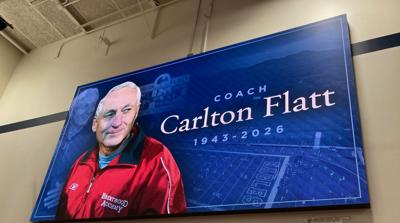
“We’ve got his picture posted on all of the screensavers on all of the TVs throughout the halls and classrooms,” Wade says. “We have the flag at half-(staff) in his honor. We have his picture up on the jumbotron, so those who didn’t know him have gotten to know a little bit about him this week.”
Ricky Bowers coached with Flatt as an assistant for five years before winning 15 state titles in football and basketball at Montgomery Bell Academy and Ensworth.
“He was a remarkable, natural leader,” Bowers says. “He had a gift of connecting young men and challenging them to be better than they would be otherwise.”
Bowers says Flatt made the game really simple. He emphasized things that mattered the most, playing with passion and enthusiasm for your school and each other, fast and physical.
“He was a force of nature and didn’t take no for an answer,” Bowers says. “I always knew him to be particularly straightforward and honest. He was candid.”
BA won three consecutive state titles from 1980-82, winning 41 of 42 games.
“Coach Flatt loved his teams and his teams knew it, and they responded accordingly,” Bowers says.
Flatt’s daughter, Lisa, drew laughter from a crowd of about 400 at her dad’s celebration of life service at BA on Sunday when she told them Flatt was cheap.
Once, he brought a tomato from his garden to Wendy’s for his hamburger and asked the cashier for a 5-cent discount.
Larry Taft covered the bulk of Flatt’s career as a sportswriter and the prep editor at The Tennessean before becoming the sports editor. Taft calls Flatt one of the most misunderstood sports figures he ever covered.
“The common tag that people put on him initially was, ‘Well, if he wasn’t at a private school, if they couldn’t give scholarships, if they couldn’t do this…’” Taft says. “Think about this: He’s won in more classifications and more state championships in varied classifications than anybody.”
Flatt won titles in Classes A, AA, 5A and Division II-AAA.
“He was just a great, great teacher,” Taft says. “Now I won’t say he didn’t have good players, but a lot of the good players he had weren’t as great as one might think.”
Flatt surrounded himself with great assistants like Bowers, Jimmy Gentry, Ray Dalton, Bobby Gentry and Tommy Owen.
Brentwood wasn’t as affluent as it is now during Flatt’s early days, and that was fine with him.
“Carlton says, ‘I liked my kids better when their parents were pig farmers and brick masons because they understand working and working hard,” Taft says.
Flatt didn’t tolerate parental coaching, but valued their support.
“Carlton reshaped high school football in Tennessee more than any person in the modern era from the 1950s on, when people went from the single-wing to the T formation to the I formation to the spread,” Taft says. “Carlton understood the logistics of placement of people on the field better than anybody else that I ever saw.”
Like coaches Pat Summit and Don Meyer in basketball, Flatt understood the importance of spacing.
“Carlton’s players ran very precise routes, and he believed in throwing the football more than anybody else playing high school football in his era,” Taft says. “He relied on the passing game.”
Flatt often went to Hartsville to watch film and videotape with former Trousdale County coach Jim Satterfield, who won 247 games and a state title with the Yellow Jackets from 1955-96.
Flatt played difficult schedules, facing top-notch teams from Alaska, Mississippi, Alabama, Kentucky and Ohio.
“He didn’t win a lot of them, but he would not pad the schedule,” Taft says. “He always thought, if he could play somebody better than him, that he and his players could learn by playing better people.”
Despite his accomplishments, Flatt isn’t in the TSSAA Hall of Fame. Taft doesn’t think it’s because of a perception of recruiting or the court battles with the TSSAA.
“I think it’s an envious thing, it certainly is,” Taft says. “It’s the saddest commentary of his life that I can think of. He deserved to be there.”
It’s unlikely that Flatt could still get in because it’s been so long since he coached that many of the voters don’t remember him.
“I believe sincerely that Pete Rose has a better chance of getting in the Baseball Hall of Fame than Carlton does the high school hall of fame,” Taft says.
Flatt’s critics accused him of recruiting.
“I think that no one could have that kind of disparaging, untruthful remark made about them and it not bother them to some extent,” Taft says. “But I think that Calton eventually got to where it didn’t bother him so much because he did have a clear conscience. That’s a pretty good repellent against that kind of dagger being thrown at you.”
Flatt, whose father was a slaughterhouse foreman at a meat packing plant in North Nashville, lettered in football, basketball, baseball and track and field at Cumberland High School.
In 1964, he was named the Ohio Valley Conference offensive player of the year as a quarterback at Austin Peay.
10 years later, Michael Vaughn became the first black student at BA. He played wide receiver and defensive back for Flatt and is an assistant now.
“When I got here, I found a safe haven,” says Vaughn, a south Nashvillian whose two brothers got mixed up in drugs and his father committed suicide in front of his family. “People treated me with love and put their arms around me and took care of me, and I didn’t have to see marijuana and drinking.
“I’m not the only kid he did this for. He was just a godsend to me and my mother. Yeah, that man saved my life and many other players. He knew I loved him, and I know he loved me.”
The coach whose first team practiced in a cow pasture made sure his players went out as winners with a 37-34 victory over McCallie in the 2006 Division II-AAA final at Middle Tennessee State — his last high school game before retiring.
“He was really brilliant, and he was great with people,” Ronnie Carter says. “So, you’ve got an unbelievable combination, and he’s just one of the best.”
Commented
Sorry, there are no recent results for popular commented articles.