
Franklin residents will likely see no change in their property taxes this year despite a significant decrease in the city’s base tax rate.
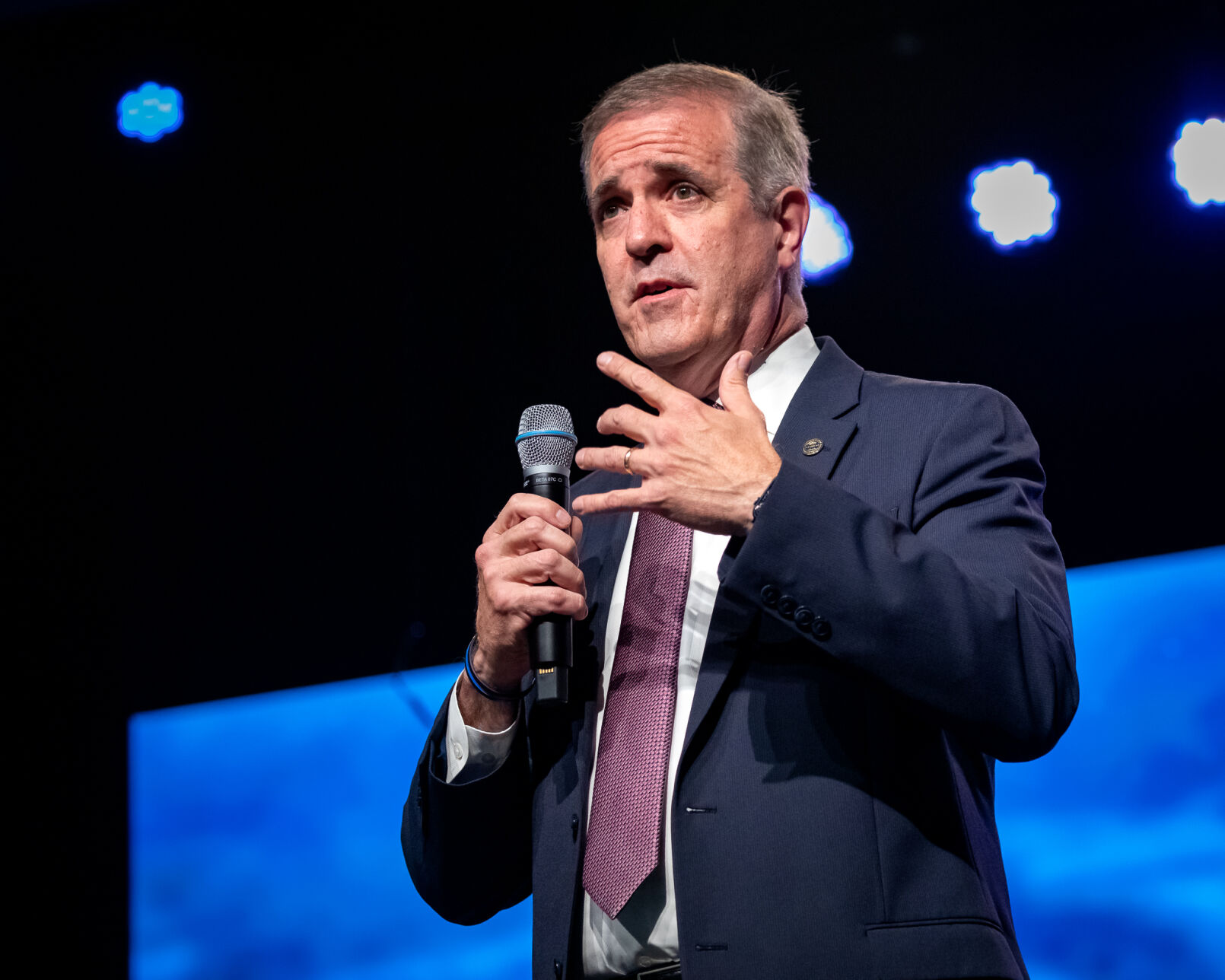
City Manager Eric Stuckey at the 2025 State of the City address.
Franklin’s Board of Mayor and Aldermen considered a draft version of Franklin’s fiscal year 2026 (July 1, 2025 - June 30, 2026) budget at a meeting on June 10. Since the draft itself is currently more than 400 pages long, Williamson Scene is breaking down the big items from new capital projects to infrastructure investments and changes to property taxes.
Every four years, the Williamson County Property Assessor conducts a reappraisal of all property in the county, which leads to a reassessment of the city’s tax base (the value of all taxable property within the city) and the base property tax rate. This year’s total tax base assessment placed the value of all property in Williamson County at $10.75 billion, up significantly from $7.6 billion only four years ago. This marks the largest increase in city history.
As a result, the city’s base property tax rate has now been lowered to $0.2310 per $100 of assessed property valuation. It was previously $0.3261 per $100. However, don’t expect your taxes to decrease just yet — city officials are proposing to maintain the current tax rate of $0.32 in order to invest in new infrastructure and public safety measures.
Franklin City Administrator Eric Stuckey put these numbers in perspective during a presentation on the budget to BOMA, emphasizing that Franklin’s tax rate remains one of the lowest in Tennessee and across the nation.
“With the new reappraisal, the average home value in the city of Franklin is just over a million dollars,” Stuckey said. “[The property tax] calculates out to about 63 cents a day for the owner of a million-dollar-plus home.”
In the proposed budget, the base rate of $0.2310 would go towards existing city operations and capital projects that are already underway.
An additional $0.068 would go towards Invest Franklin 2.0, the city’s new capital projects initiative and the second iteration of the city’s 2016 initiative, Invest Franklin. Invest Franklin 2.0’s top priority would be collaborating with the Tennessee Department of Transportation to expand Mack Hatcher Parkway Southeast (the portion from Murfreesboro Road to Columbia Avenue) from two lanes to four. The project has already been approved and is a part of TDOT’s 10-year capital program.
The city also hopes to use Invest Franklin 2.0 to eventually work with TDOT to expand Mack Hatcher Northwest, the newly built portion of the highway spanning from Hillsboro Road to New Highway 96.
The final $0.021 of the $0.32 tax would go toward broadening city operations and service delivery. As Stuckey explained, the city hopes to use these funds to address public safety concerns and increase the capacity of Franklin’s public works to match a growing population.
The new budget accounts for 10 new positions, including three new on-shift firefighters, three new patrol police officers, and a new victim support counselor in the police department. The city will also provide all city employees with a base pay increase of 2.5 percent, with a performance-based raise of up to an additional 2.5 percent. According to Stuckey, these increases move compensation for Franklin city employees to the top 10 percent of the “market target” for local government work, often a priority to recruit and maintain top talent.
The city also plans to update equipment, including new brine-producing equipment to clear ice from roads in winter and new vehicle barriers to secure downtown festivals.
Other changes (all potentially effective January 1, 2026) include a $2 per month increase in residential trash and recycling collection fees, and an increase for water and sewer rates of 6 percent and 5 percent, respectively. Also, Franklin’s Parks Department will now be called the Parks and Recreation Department — a move with no cost to the taxpayer, simply to better reflect the department’s responsibilities.
Stuckey emphasized that the city understands the burden additional fees can place on the taxpayer, and that he is confident that all funds are going towards initiatives that will genuinely improve the quality of life for Franklin residents.
“We don't take lightly the tax impact that we make from the decisions we make … but feel that that increase, which is not significant on the day to day basis, can have significant impact going forward, both with capital projects, but also service delivery for our community and continuing to provide a high quality of service to the citizens of Franklin,” Stuckey said.
Aldermen Discuss Tax Rate Amendment
After Stuckey’s presentation, BOMA launched into debate over the new proposed property tax rate. Ward 4 alderman Patrick Baggett proposed an amendment to the budget that would change the property tax rate to $0.286, which he said would be inclusive of base tax rate of $0.2310, the $0.021 for an increase in operational costs, and additional $0.034 to specifically fund the construction of two additional lanes on Mack Hatcher Southeast.
Baggett said that he did not want to advocate for additional expenses as he wanted to tell constituents exactly what the city would be doing with their tax dollars, calling potential plans to expand Mack Hatcher Northwest a “pipe dream.”
“I'm just asking for a receipt,” Baggett said. “What I've heard [from the public] is ‘Thank you for not taxing us for something that's not going to happen.’”
Alderman at-large Greg Caesar agreed with Baggett, saying that he wants to give constituents a “clear vision” and is hesitant to increase capital project taxation for the expansion of Northwest, which is not yet approved.
“It’s tough for me to say, let's just go ahead and collect the money, and then we can find the place and we can allocate it if the funding does come through from the state,” he said.
However, Alderman at-large Clyde Barnhill disagreed with Caesar and Baggett, arguing that the city has plenty of specific projects beyond the expansion of Northwest that could benefit from the additional funds gained from the $0.068 portion of the total $0.32 tax.
“I don't see how anyone can sit here and go over the hundred or so projects in the capital improvements project and say that they cannot pinpoint something specific that that money goes to,” Barnhill said.
During the conversation, Ward 1 alderman Beverly Burger recounted the results of a survey conducted via a mass email to her constituents. Of the 140 responses, 9 voted to only pay the base tax rate, 18 voted to pay the proposed rate of $0.32, 62 supported a $0.29 tax, and 71 agreed with Baggett’s proposed $0.28. As a result, Burger said she would support the amendment.
The amendment failed in a 5-3 vote, with aldermen Barnhill, Blanton, Peterson, Brown, and Potts voting against and Caeser, Burger, and Baggett voting in favor.
Before a vote on the original motion, Mayor Ken Moore briefly weighed in, saying that he supports the proposed tax of $0.32 because the city has a long list of improvements to do that already cost more than they can achieve with that tax, and that narrowing simply to large planned projects can limit the city’s capabilities.
“There’s no way we’re going to do what we want to do or need to do anyway. But I think you miss an opportunity if you try to narrow and focus that and give somebody a receipt for what they’re getting,” Moore said.
The proposed budget with a $0.32 tax passed on a 5-3 vote, with aldermen voting in the same groups as on the amendment.
The next BOMA meeting will be June 24, where the board will likely consider the third and final reading of the proposed budget.


Commented
Sorry, there are no recent results for popular commented articles.