


Republican leadership continues to present their education reform as an opportunity to give parents school choice that would not harm public schools.
“We are compelled to make sure these kids get educated, and ultimately, the vast majority of those for the rest of our life is going to be in the [public school] system,” Senate Majority Leader Jack Johnson (R-Franklin) said at a meeting on Friday. “Let’s all be committed to making that the best possible system. But, that system that we run is failing some kids. It's not providing the best education, and we think that parents ought to be able to pick a different option for the kid.”
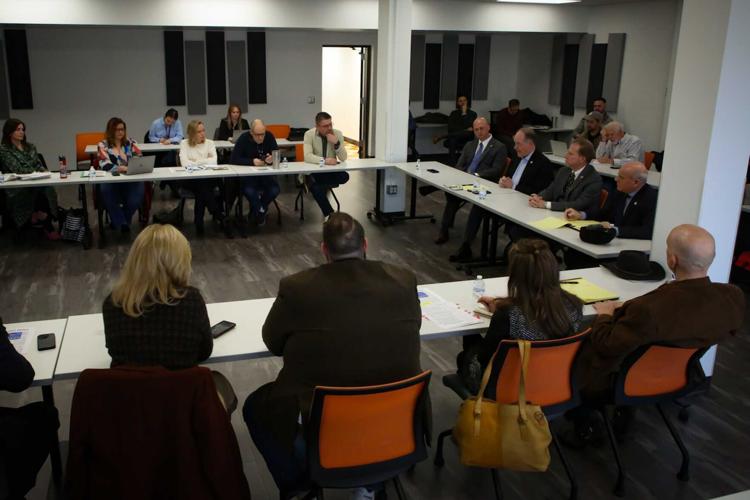
At a meeting between the Williamson County School Board of Education and the local delegation of lawmakers, the group discussed the upcoming special session legislation for Gov. Bill Lee’s Education Freedom Act – school vouchers or “scholarships.”
“We pay, on average, for every kid that's attending a public school $7,075 and that's the amount of the scholarship,” Johnson said. “So, we are constitutionally obligated to make that available. You shouldn't have to use it in the public school that you’re zoned for; the vast majority of families do and will continue to do that.”
The bill will allow for 20,000 of those scholarships and provide that funding to students whose parents choose to place them in a private school, defined as a category I, II or III school approved by the commissioner of education and located in the state. Half of the scholarships can go to any student while the other half are income-limited, reserved for students who attend an achievement school district or who have disabilities.
The household income limit is described at 300 percent more than those who qualify for reduced-price lunch. The fiscal note attached to the bill explains that, currently, an income limit for a family of four to qualify for reduced-price lunch is $57,720. So, a family of four would qualify for the school voucher if their household income did not exceed $173,160.
One board member asked if the student’s funds could be used if they were to go to another public school that allows for open enrollment. As it stands now, the student cannot receive the funds if they are enrolled in a K-12 public school.
“It is not in the bill now,” Johnson responded. “We may have a conversation, either in special session or later, [that] if you do allow for open enrollment across districts and you charge out of district tuition that perhaps these could be used to pay for that out of district tuition.”
Some of the board members had concerns about the public funds being distributed to private schools which do not have to follow the same requirements that public schools do. The schools do have to provide either a nationally standardized achievement test or the TCAP test required for the student’s grade-level. However, there are still concerns that the funding being given to private schools through the voucher could affect public schools budgets. Johnson says there is a funding floor implemented in the bill to prevent school districts from losing money if their enrollment decreases due to students with scholarships who leave.
Because of that funding floor, the new education legislation is expected to add $3.3 million to the public school funding formula, known as TISA, in its first year to keep school budgets at their current level. However there is an estimated net decrease in TISA funding each following year for at least $44.9 million, according to the fiscal note provided for the voucher bill by the state’s fiscal review committee.
The board and legislators also discussed that Williamson County only gets about $4,000 rather than the $7,000 proposed to go to private schools under the new bill which is more of an average as some counties get more while Williamson is on the lower-end of the TISA formula.
Johnson says he believes Williamson County gets a bad deal with the TISA funding formula. He says he has proposed a separate funding mechanism for higher performing districts, such as Williamson County. In his appropriations bill filed for the special session, there is an appropriation for a recurring $17 million “pool of funds that can go to state districts that meet a certain qualification.” He says as that criteria stands right now that could mean around $4 million to Williamson County.
Johnson says that has support from the governor’s administration as well as House and Senate leadership. The appropriations bill for the special session has been filed but no details are available online at the time of publication.
Before the meeting with the school board, the legislators also were a part of Policy Talks hosted by Williamson, Inc. Rep. Todd Warner (R-Chapel Hill) explained his opposition to the education bill and said he didn't think it should be brought under the special session.
"I think you the citizens have the right to vet these bills, watch them go through the proper process and get time to comment on these bills. When we rush things through, when we suspend the rules, when we go into flow motion – I think that's wrong ... What I do think could happen here is the taxpayers could actually be funding education in this state three times through these scholarships if President Trump does something at the federal level. I think we just should give it some time." Warner said to applause in the room. "The special session should be about East Tennessee and it should've happened three months ago."


Commented
Sorry, there are no recent results for popular commented articles.