
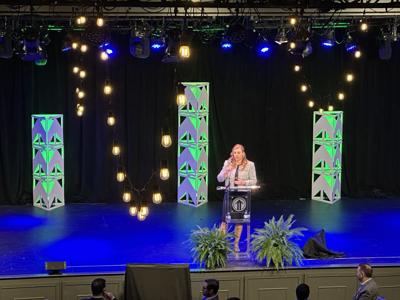

In opening the annual Outlook Williamson event, ThinkTennessee President Erin Hafkenschiel presented a detailed review of where Williamson County succeeds and where it faces opportunity for growth, according to data and research that the nonpartisan think tank has collected.
"The biggest challenge, of course, for Williamson is how to preserve the county's community character and quality of life as you grow," Hafkenschiel said.
Starting with some of the basics about Williamson County economic indicators, Hafkenschiel shared that it "leads in income, wages and unemployment" and "nearly 60 percent of the county makes over $100,000 per year, which is pretty astounding." The county's average wages are nearly double the average Tennessee county, which is around $48,000.
Williamson County has the highest cost of living among counties in the state. Hafkenschiel shares that housing, child care and energy costs are a few of the indicators that are driving that cost up. Williamson leads the state in child care costs, coming in around 12 percent of household income while the average for the state is about 24 percent.
"Seven percent is what's considered affordable," Hafkenschiel said. "So even though Williamson County is leading in this indicator, the child care cost burden in the county is nearly double what's considered affordable."
When it comes to health outcomes, the county is leading the state in many ways. However, because the state ranks low in many of these areas among other states, there is still room for improvement on the county level, Hafkenschiel explained. For example, the national average for youth obesity in 2020 was 15.8 percent while Williamson County is at 24 percent.
The county leads the state in many education indicators, including graduation rates. But, that rate is not the same for students of all income levels, which Hafkenschiel pointed out as an area of opportunity. Around 68 percent of people in Williamson County have an associate's degree or higher, which she said was "astronomical compared to peer counties" with the average at around 26 percent.
Looking at both the county and state data, Hafkenschiel identified housing, transportation, women's leadership and child care as four areas of opportunity for the county.
"Williamson County has a challenge in creating more affordable rental units," Hafkenschiel said. "Fifty-two percent of Williamson County homeowners make over $150,000 a year. But then compared to renters across the state, there is much less housing that's affordable to renters across those different pay scales. This is not just a Williamson County issue. This is something that we're struggling with all across the state."
She explained that the state has added 200,000 new jobs over the last three years but only added 154,000 homes. Citing a statewide home shortage of around 120,000, Hafkenschiel adds that, based on estimates she has seen in some large counties, even that is likely underestimated.
She explained that a result of the housing supply shortage means prices are increasing. The state's median home sales price is $339,000 and home sale prices have increased 17 percent since 2013. Rent has increased by 51 percent in that time period, she said, calling that a "staggering" amount.
"Housing and transportation obviously go hand in hand," Hafkenschiel said. "They're inextricably linked. We know many people are moving further out into the region and often farther away from their jobs in search of more affordable housing.
"Of course, housing and transportation are linked to our land use, particularly our ability to preserve green spaces and preserve ag land. ... If Williamson County wants to preserve its rural character, there will need to be some zoning changes within the urban growth boundaries and the existing cities. But in order to make this work for Williamson County residents, it would be a good idea to test out some of these strategies in a few pilot areas."
Hafkenschiel shared a Williamson County Planning Department study that showed growth of housing developments that would occur outside of the urban growth boundaries in places that are currently considered rural. The study showed that the current growth pattern would cost the county $5 billion over the next 20 years, including $330 million on transportation improvements. The study showed a second scenario for growth called the "town and country" model that would reduce the number of housing units outside of the urban growth boundaries and save the county $3.5 billion in costs, including more than $100 million in transportation infrastructure.
The planning commission received community feedback on the two scenarios that showed 92 percent of support for the "town and country" model. To make this work, Hafkenschiel said it will take a focus on missing middle housing (housing between single-family and apartments) as well as mid- and high-rise apartment complexes for more mixed-use development with a priority around design for pedestrians.
"I know that this is a really challenging conversation, and it's one that Williamson County is going to be talking about for quite a while," Hafkenschiel said. "But if you just think about building more places that people love, places that you want to be, I know that Williamson County's up to the challenge."
Hafkenschiel shared that Williamson County has the potential to lead the state and potentially the nation on developing a solution for child care. The county is first in the state for a low child care cost burden, but she cited her earlier explanation that it is still nearly double what is considered affordable. She said the state does not have enough facilities to support the growth, adding that it is only meeting about 70 percent of demand.
"There are lots of strategies being explored to improve child care availability, making it easier to open facilities, programs for employees, subsidies for low-income families, incentives for child care workers," she said.
"We do a lot of work with other state-based policy organizations across the country, and oftentimes there's a playbook that you can borrow from other states. In child care, that's simply not the case. No one else has figured this out yet, and I think it's an opportunity for Williamson County to really lead on figuring out how we can provide high-quality child care that's good for families, good for children and good for child care workers."
Overall, Williamson County ranks first among all Tennessee counties in 43 of the more than 100 metrics that ThinkTennessee measures. Hafkenschiel cautioned that does not mean there are no challenges ahead like preserving the rural character and improving quality of life while maximizing access to opportunities for all residents.
The Outlook Williamson event was hosted by Williamson, Inc. on April 1 and also included talks about artificial intelligence and community developments that are under planning and construction.
Editor's Note: The Williamson Scene is a media sponsor of the Outlook Williamson event.


Commented
Sorry, there are no recent results for popular commented articles.