
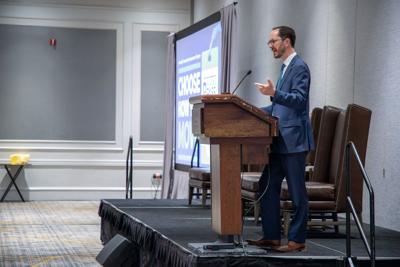


Nashville Mayor Freddie O’Connell joined Franklin Mayor Ken Moore for the opening session of a statewide transportation conference hosted by the Tennessee Public Transportation Association in Cool Springs — and focused on the continued need for collaboration.
Steve Bland, Nashville’s WeGo Public Transit CEO and president of the TPTA, introduced the mayors and highlighted the importance of the regional connectivity that Middle Tennessee is working towards.
“I have thoroughly enjoyed the 10 years I've been here in Tennessee, enjoying the warmth and the friendliness, but I'm going to revert to a little bit of my New Jersey roots and say, if anybody can come up with a better mayor than these two for public transportation, I will take you out back and fight you right now,” Bland joked, gathering a laugh from the breakfast crowd.
Bland noted that the two mayors both serve on the Greater Nashville Regional Council, the Regional Transit Authority and the Transportation Policy Board. Moore added that the mayors work together often and that collaborative leadership leads to improvement for all of their communities.
“I think the message to take away today, at least from our region and our city, is that we all continue to work together on a regional basis, having conversations to move the entire region forward, rather than just one city or one area,” Moore said.
O’Connell shared that he traveled to Denver when he was serving on the board of directors for the Nashville Metro Transportation Authority with former Mayor Karl Dean. From that trip, O’Connell said two things were formed: the Regional Mayors Caucus, with Moore as a founder, and the nonprofit Transit Alliance of Middle Tennessee. O'Connell went on to share how Moore was involved along with several other state and Nashville partners to pass the IMPROVE Act in the statehouse in 2017, allowing cities and regions to pursue dedicated funding for transportation and infrastructure.
“Quality of life here in Middle Tennessee continues to attract people from all over the country,” O’Connell said. “But that decade of future growth means that we have to interact with it successfully. So we spent the past year crafting a Transportation Improvement Program compatible with the IMPROVE act … We want this to be something that is a pathway to successful, sustainable growth for not just Nashville, but the entire Middle Tennessee region.”
O'Connell went on to share the core four principles of the Choose How You Move plan of sidewalks, service, safety and signals and explained that it uses a half cent sales tax as an approved funding source from the IMPROVE act. O’Connell said the group visited Denver in 2008 because Nashville was forecasted to have in 2040 the same population as Denver had at that time (about 2.5 million in its metropolitan statistical area). The mayor said his hope is that if the transit referendum passes, it will increase the success of the region as each city continues to grow.
Following the two mayors, Tennessee Department of Transportation Deputy Commissioner and Chief of Planning Preston Elliott shared an update on TDOT’s plans as well. He highlighted the Transportation Modernization Act from 2023, which gave the department the opportunity to use public-private partnerships for Choice Lanes, the first of which will be in Middle Tennessee along Interstate 24 between Nashville and Murfreesboro.
“The advantages that we saw from Choice Lanes when we went around the country, and how communities were able to improve more reliable trip times, improved transit and transit operating in these lanes for free,” Elliott said.
He added that TDOT is in the preliminary design and environmental stage of the I-24 corridor project and that, by the end of the year, the department plans to submit some draft environmental documentation to the Federal Highway Administration. After that, TDOT can begin working on its public-private partnerships. Elliott also said that the Nashville Choose How You Move program would influence the level of operational opportunity for mobility along the corridor.
“We're very excited about that because those projects in Choose How You Move dramatically impact the flow of traffic in and around the Nashville region — better signal timing, sidewalks to transit, transit operations are all the things that are needed to address our mobility needs in the Middle Tennessee region,” Elliott said.
Commented
Sorry, there are no recent results for popular commented articles.