


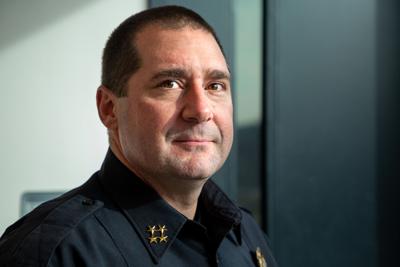


Brentwood’s new Chief of Police Jim Colvin has stepped up to lead the department following the retirement of Chief Richard Hickey.
On Friday, the now-retired Hickey was recognized for his decades of service to the city in a retirement ceremony at the John P. Holt Brentwood Library, and Colvin will have a ceremonial swearing in during Monday night’s city commission meeting
“I wouldn't be leaving if I didn't think that the future was right,” Hickey said. “This police department, this city, is in great hands going forward. So I'm going to go out and retire and try to have a little fun.”
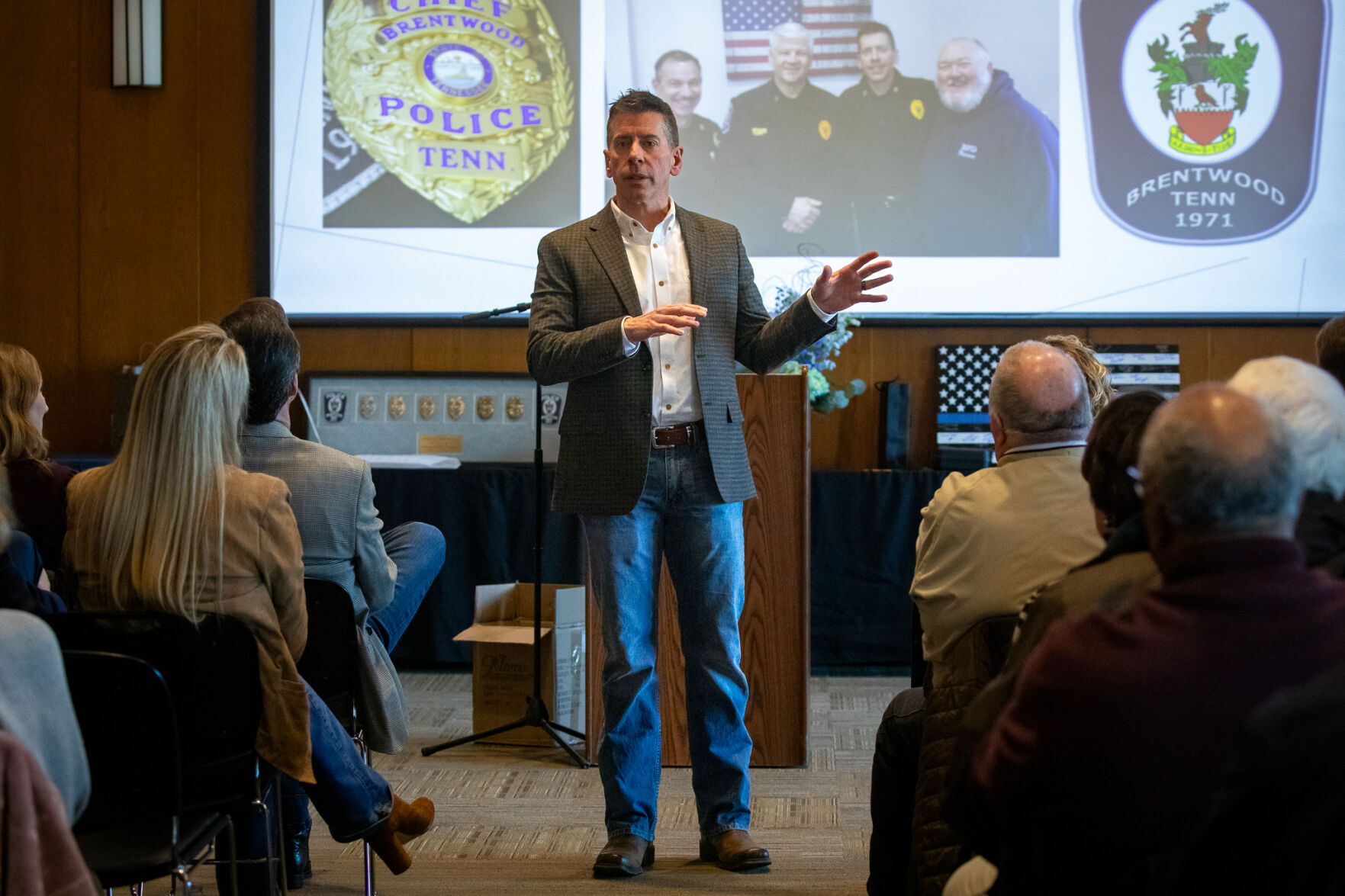
Brentwood Police Chief Richard Hickey speaks to family, friend and community and government leaders at his retirement ceremony at the John P. Brentwood Library, Feb. 21, 2025.
The Williamson Scene sat down with Colvin ahead of his first day on the job to detail his goals and priorities as the now fifth chief of police in the city’s history.
What are your short term goals for the department?
I'm taking over a well-established police department that's had tremendous leaders for 50 plus years. I don't have to make a lot of changes. I really need to maintain what we have and just do some fine tuning. We have a tremendously talented group of officers, dispatchers, civilian personnel and our command staff. Our command staff has changed significantly in the recent years and will change more with this promotion, and so I'm going to have to focus a lot of my time just making sure that our young command staff members, our young supervisors, are getting the support that they need from me and from the assistant chief as well.
What are your long term goals over the next ten years, after which you plan to retire?
I think 10 years is plenty of time for me to accomplish a number of goals. Just try to improve the quality of work – that we're providing job satisfaction for our officers and professional staff. And then in 10 years, it will be time for there to be a new chief. You need new ideas. You need a different energy. There will come a time where I need to step aside. So I'm already looking at, how do I prepare the next generation of leaders, and that starts with hiring the right people and then retaining them right while also supporting them and providing them the training and resources they need to succeed. So I have to make sure that I continue to do what we've done for a long time here, but do it at a level that I can feel confident about leaving in 10 years. Knowing that the next generation, and probably the one after that, are prepared to lead this department, because we're very proud of the fact that we've only had I'll be the fifth chief of police, and all internal promotions, I would love to see that continue.
Has the structure of the command staff changed with your promotion?
Our organizational chart is staying the same. They're all internal promotions. So they're people that are known commodities here within the police department. They're proven and they've excelled at every position they've been at, so they're ready for the next step. It's just a matter of supporting them, giving them the guidance that they need.
Is promoting from within part of the larger strategy?
From the day someone starts here, they receive top notch training. We invest a lot of money and time into our training program. We support them throughout the academy. Once they get out, we have an extensive field training program. Once they're released on their own, there's a probationary period they have to complete, and once they're fully released off of probation, they're riding in their own car, responding to their own calls once they're established here, we're focused on … how can we use them in this police department? By utilizing their strengths, and throughout that process, your leaders develop. There are people that stand out and you know that they're ready to take the next step in their career. So when the opportunity arises, they typically test well and achieve those promotions. Everything here is earned, so I think it's good for officers to be able to start here on day one and know that they could end their career at the very top, if they choose to go that far.
Was leading a department a goal of yours when you started out in law enforcement?
I didn't even consider it. I just wanted to be a police officer. It was one of the only jobs I was ever interested in doing, and that was my only focus, was getting hired, making it through training and being able to go serve people. I wasn't concerned about the money or any rank or whether I was going to work holidays or weekends or what my days off were going to be. I never considered any of that. And it wasn't until, I think probably my second promotion where my wife and I talked about the future. … My ultimate goal once I made lieutenant, was to make captain. And I thought, if I can get promoted one more time, I can at least have kind of a normal work schedule, right? And that was for my family's benefit, but that was really as far as I had thought about anything.
What are your top enforcement and/or criminal investigative priorities?
I'm going to spend a lot of time focused on our traffic unit and making sure they have everything that they need from a criminal investigation standpoint. … We have very low personal crime numbers, historically and still today, we want those to remain low and maintain our presence out in the community, making people aware that we do have investigators that work very hard and have a high solvability rate for the crimes they investigate. If people are aware of that, hopefully the criminals will stay out of Brentwood.
Are there any new technologies that the department is planning on adopting or upgrading?
We are looking at improving or upgrading our Tasers, and so that's something that we're working on right now. We're going to maintain, obviously, our body cam program, along with our in-car cameras that have license plate readers built in. We have license plate readers throughout the city, but that's a program that we're currently expanding. … So much of our evidence now is digital, and we use a fairly expensive workstation to help process the digital evidence, so we're looking at securing the funds to purchase a new one of those. I think the biggest thing that I'm going to have to tackle is … a system to help train our officers.
There's a lot of new technology, and a lot of it is centered around virtual reality training, and they're just getting to the point where they're viable training solutions. So, I need to look and see how we're going to invest in those types of systems, because our lease is almost up for our current system, the VirTra system, and so we're looking at, if we [are going to] continue with VirTra, or if some of these new technologies are worth investing in, and VirTra does have a VR system that we're looking at too.
You are a recent graduate of the Federal Bureau of Investigation's National Academy. How are you planning for potential changes at federal law enforcement agencies, namely the FBI, including the department’s access to federal resources and grants?
Most of the things that we do are funded by the City of Brentwood, and so we don't have to rely on a lot of those grants for much of what we do now. They are helpful, and we don't want to turn away free money, but at the same time, the city has done a really good job of budgeting and making sure that we have what we need, so I don't worry about that as much. As far as our partnerships with state and federal agencies, much of the time when we reach out to a federal agency for assistance. It's really because we already have the case figured out, but [a suspect/defendant] might get more time or be punished at a different level if it goes federal. And so we can charge them with the offense here in Tennessee, but if we get them charged federally, there may be a benefit from a sentencing standpoint, and that's the majority of the reason we reach out to them. It's typically not for resources. It's typically if we have a case solved, and we would like their help from a sentencing standpoint, for them to take it federally.
The FBI National Academy was a tremendous resource for me, because I have 250 people in that class with me, and I have contacts all over the United States, and we could reach out and receive assistance from any of those departments and law enforcement in general, obviously very supportive of each other. You can pick up the phone and call any police department where you don't even have a contact, and if you have a case that might help them, or they have a case that could help you, you're going to work together with them.
What will BPD’s involvement be with the federal and now state-level focus on immigration enforcement, including intelligence gathering and sharing as well as physical enforcement?
We will obviously comply with state laws, and we will continue to work well with our partners, whether that be locally, state or federal level, our mission, again, is to take care of the citizens of Brentwood, Tennessee, and so that is always going to be our number one priority. But if we have partners that are asking for assistance, regardless of what type of crime they're asking for assistance on, if we're able to assist them, we will, but that comes after we've taken care of our needs here within the city of Brentwood. So this is our priority, and this is where our focus will remain.
Commented
Sorry, there are no recent results for popular commented articles.