
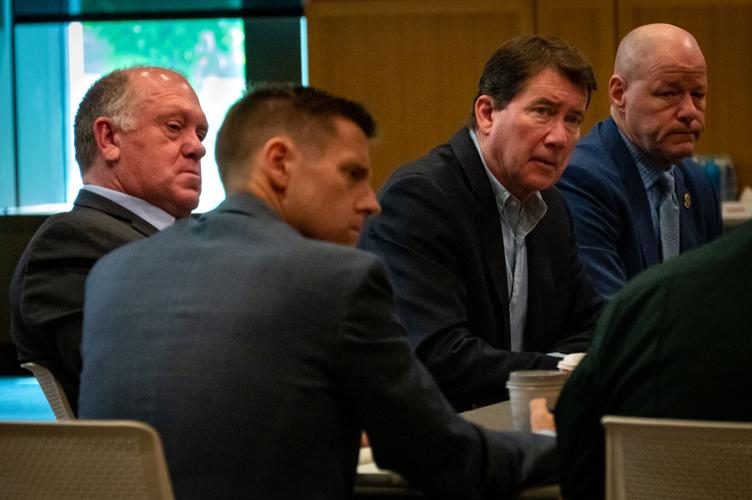



Tennessee’s U.S. Senator Bill Hagerty led a roundtable discussion in Nashville on May 22 with former Acting Director of the U.S. Immigration and Customs Enforcement Tom Homan and various state and local law enforcement and government officials discussing border security.
The discussion took place at the Tennessee State Museum and included among the local leaders were Tennessee Bureau of Investigation Director David Rausch, Williamson County Sheriff Dusty Rhoades, 12th Judicial District Attorney Courtney Lynch and Carter County Mayor Patty Woodby.
Hagerty called the influx of immigration and drug trafficking at the United States southern border with Mexico the “largest national security crisis that our nation has ever seen.”
Homan, who served in the top ICE position from January 2017 through June 2018 called the border “unsecure” and said that many people seeking legal asylum in the U.S. aren’t actually refugees seeking asylum, as economics alone is not enough to guarantee legal asylum protections in the U.S.
“They don’t come here for a better life, they come here for a job,” Homan said.
The U.S. has a long history of official and unofficial political, military and economic influence and intervention in Central and South America, leading to the destabilization of nations and their economies which have in part fueled the ongoing immigration crisis.
Homan spent much of his time falling back on praises of his former boss, President Trump, blamed “illegal aliens” for contributing to the closing of rural hospitals, and raised concerns that immigration could fuel outbreaks of tuberculosis, measles and chicken pox in schools.
TBI Director Rausch said that Tennessee has become “a hub for those getaways” — people who successfully enter the U.S. illegally — some of whom he said are either members of Mexico’s numerous cartels or associated with them, specifically citing the state and nation’s ongoing opioid crisis, which has evolved with the widespread us of drugs like fentanyl and xylazine, some of which has been linked to China.
“Today, we’re making cases on cartel members that are here in Tennessee that are running operations, and their distribution network, frankly, is better than Amazon,” Rausch said, adding that law enforcement is seeing drug smuggling operations connected to other crimes including human trafficking and leading to violent crimes across the state.
“The violent crime that we’re seeing in Tennessee, 90% or better, can be connected to this issue,” Rausch said.
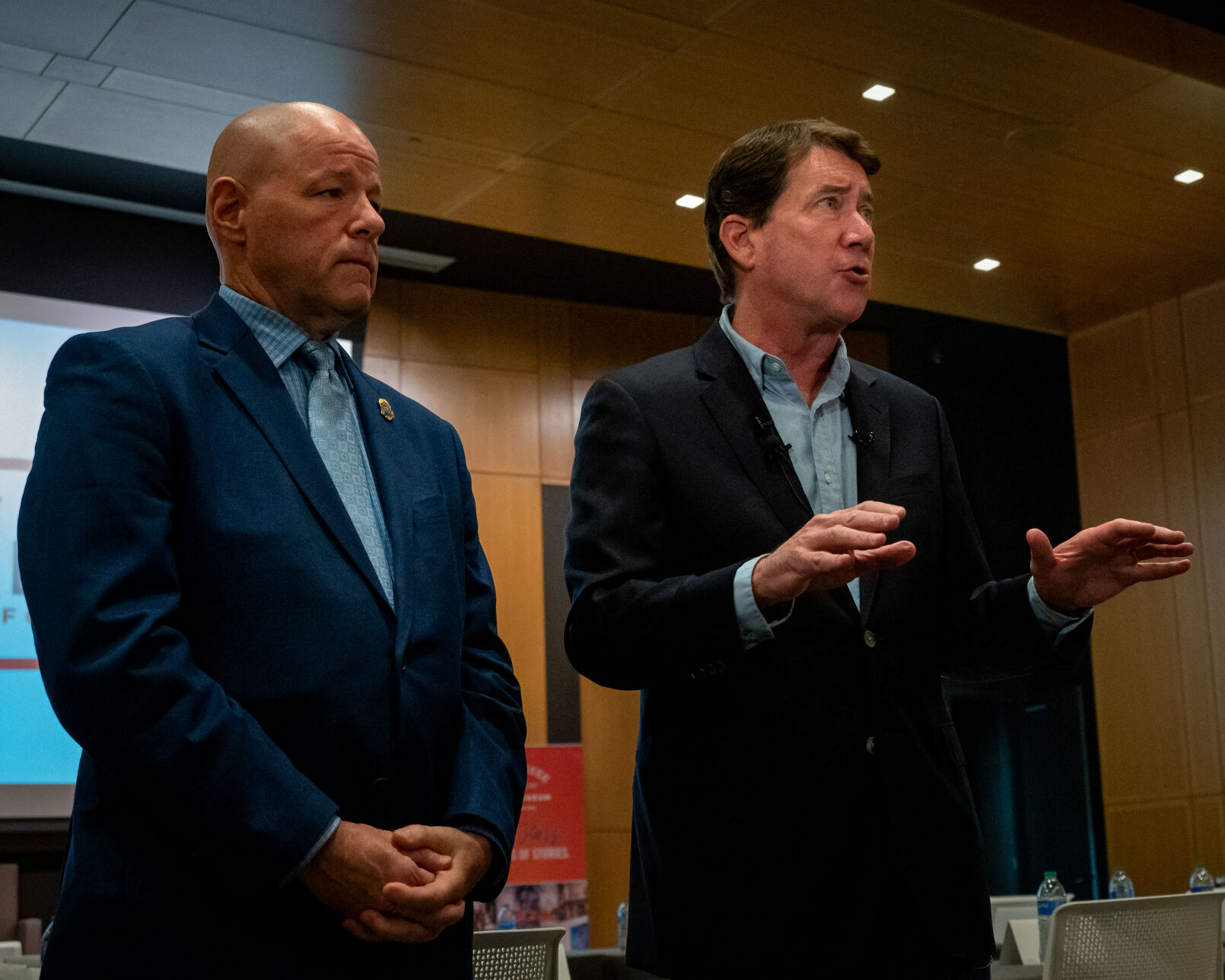
TBI Director David Rausch and Sen. Bill Hagerty speak to reporters at the Tennessee State Museum on May 22, 2023, following a rountable discussion on U.S. border security.
Concerns that the northern and southern U.S. borders could be exploited by known terrorists or terrorist groups seeking to enter and target the U.S. mainland have been raised for years, and in 2022, the U.S. Border Patrol reported that they encountered 98 people who were on a “terrorist watch list.”
According to Bloomberg, that number represented just 0.0044% of overall encounters of noncitizens at the northern and southern borders.
In 2021, 16 people on the watch list were encountered at the country’s borders, with three reports in both 2020 and 2019. Despite the relatively low numbers, those concerns remain with law enforcement.
“It’s not about immigration anymore, it’s about national security,” Homan said, while also alleging that the Biden administration is intentionally acting to reduce the security of the southern border.
“I share your concern about terrorism, " Raucsh said. “We know they’re here and now the question is if we have the systems in place that are going to be able to stop them committing as egregious or worse than what we saw on 9/11; I’m not sure we do.”
Homan and Rausch joined calls from some Republican officials calling for the designation of some or all Mexican cartels as foreign terrorist organizations, a move that could increase the U.S. Federal Government’s ability to prosecute cartel members and those who provide the groups financial or material aid in the U.S., such as American-made and sold guns that often make their way to Mexican cartels.
Homan also joined calls for further direct intervention from the U.S. federal law enforcement officials and U.S. military special forces to combat cartels in Mexico.
In March, Mexican President Andres Manuel Lopez Obrador pushed back against any suggestion of U.S. military intervention in Mexico, saying that such a move would violate Mexico’s sovereignty.
Following the discussion, Hagerty and Rausch took questions from the press, but failed to directly address the potential impact to Americans on American soil if cartels are targeted further by U.S. law or a military conflict.
“The biggest concern that we have is dealing with these narco-terrorists,” Hagerty said, with Rausch saying, “We are unable to defend ourselves right now, so it’s not an escalation by the U.S. with that designation, it’s actually building our defense to be able to protect ourselves.”
Mexican cartels have long targeted politicians, law enforcement and journalists in brutal and sometimes public attacks which have resulted in hundreds of thousands of deaths over the past decade. Some fear that U.S. intervention could bring that violence not just to America’s doorstep, but inside the nation’s borders.
“They won't limit their war to American police officers, politicians, and journalists,” Rogan wrote. “They will kill children and families. Maybe that is an acceptable cost to break the cartels back and save more lives in the future. But the prospective costs should be considered.”
Gov. Authorizes Troop Deployment to Southern Border
On May 25, Gov. Bill Lee authorized the deployment of 100 Tennessee National Guard troops to "secure the U.S. Southern border amid an ongoing national security crisis and surging drug crisis being fueled by an open border."
While the border is not actually "open," as evidenced by the presence of the U.S. Customs and Border Protection agency among other Federal and state law enforcement agencies, the deployment comes as some Republican officials push for increased border funding following the end of the Covid-era Title 42.
Those Tennessee National Guard members will deploy "at the end of May" and will support security efforts through "patrolling and providing additional security presence along the border; assisting road and route clearance, barrier placement and debris removal; and staffing outpost operations."
“America continues to face an unprecedented border crisis that threatens our nation’s security and the safety of Tennesseans,” Gov. Lee said in a news release. “The federal government owes Americans a plan to secure our country, and in the meantime, states continue to answer this important call to service. I am again authorizing the Tennessee National Guard to help secure the Southern border, and I commend these troops for providing critical support.”
Tennessee service members have participated in similar deployments in the past including in 2021.
“The men and women of the Tennessee National Guard are always ready to serve their country anywhere, anytime,” Tennessee’s Adjutant General Brigadier General Warner Ross said. “These troops are a capable contingent that will continue our long-standing tradition of responding to the call to aid our fellow Americans. The Tennessee National Guard is proud to serve and support our state partners in safeguarding the United States along the U.S. Southern border.”
Commented
Sorry, there are no recent results for popular commented articles.