
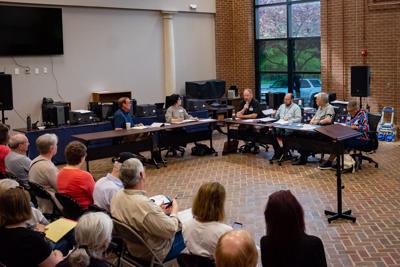

The Williamson County Commission approved the purchase of new election voting machines in a 16-8 vote on Monday, June 12, following weeks of public debate about how elections are administered and secured in the county.
Commissioners Gregg Lawrence, Mary Smith, Barb Sturgeon, Lisa Hayes, Jeff Graves, Pete Stresser, Drew Torres and Christopher Richards all voted against the purchase.
The $909,279 purchase through grant funding ended the uncertainty over voting systems in the county, which appeared to be in a state of limbo after the commission initially declined to approve the purchase of the Election Systems and Software (ES and S) voting machines during their May meeting.
The June county commission meeting was tense at times with cheering and heckling from some audience members who were against the electronic voting machines.
“The purchase that the Williamson County Commission approved provides us with a system that gives us the ability to continue to conduct secure elections that a vast majority of Williamson County citizens are proud of, while also giving us the ability to improve the voting experience for the voter,” Williamson County Election Commission Chairman Jonathan Duda said in an email.
Public debate has swirled around the issue, with a small but vocal group of citizens voicing concerns over election security and election integrity.
Some of those concerns centered around a 2021 software error in Franklin municipal elections which were addressed and did not alter the outcome of the election.
Other concerned citizens relied on unfounded claims of wider election fraud. One citizen has claimed, without evidence, that voting machines in Williamson County have been "hacked." The Election Commission has disputed those unfounded claims.
While electronic voting can be compromised, Duda has argued that relying solely on the hand counting of ballots, as demanded by some citizens, can also be compromised, either through human error or by intentional acts, which he said are harder to safeguard against when only relying on hand counting.
Duda also said that hand-counting ballots would be both inefficient and more expensive, and state law requires that voting machines be used in precincts with more than 300 registered voters, meaning that the county can't legally solely rely on the hand counting of ballots.
While Williamson County’s current and soon-to-be acquired voting machines do electronically record votes, they also produce a paper record of that vote.
Last year, the election commission completed an audit of the Nov. 2022 general election showing 100% accuracy in the results.
According to the online county commission agenda, the approved purchase “includes the capability to add hand marked ballots, if desired.”
On May 18, the election commission unanimously approved a resolution to hire a third party to conduct a feasibility study which will examine the inclusion of hand-marked paper ballots. The findings of that study are expected to be presented to the County Commission in 6-12 months.
Duda has expressed his personal support of hand-marked ballots and has said that the election commission appreciates the community input and engagement.
"I am appreciative of the invaluable feedback we received throughout this process, and especially from county commissioners and others who expressed confidence in the work that Administrator Chad Gray and the staff of the election commission are doing," Duda said. "We are going to continue to work hard for the citizens of Williamson County to conduct elections that voters will have confidence in."

Commented
Sorry, there are no recent results for popular commented articles.