


PART FOUR
Moving the Lee-Buckner school from Spring Hill to Franklin gives the Heritage Foundation a space to paint an even bigger picture of education through the years in Williamson County.
“With Franklin Grove being such a historic property that goes back several centuries, I think that it's an opportunity to tell its African American history as well,” Finch said.
Franklin’s first Freedmen Bureau school, which taught newly freed slaves how to read and write, was in one of the homes on the property after the Civil War. The McNutt family was forced from their home in 1863 during Franklin’s federal occupation after the war. While they were gone, the house was rented out around 1866 to a Black teacher. The New York-based American Missionary Association that worked with the Freedmen’s Bureau documented its first teacher, Rev. Edwin H. Freeman, in Franklin at that same time. The McNutts returned home and the school moved out.
“To tie the Freedmen Bureau school history and connect the dots and string the pearls to the Lee Buckner Rosenwald school to then the Civil Rights Movement and the legacies of African American education that spans well over 100 years to modern day – it's simply going to be a significant step forward for our county in how we recognize our history, tell our history, and reckon with our history in a very meaningful and inspirational way,” Finch said.

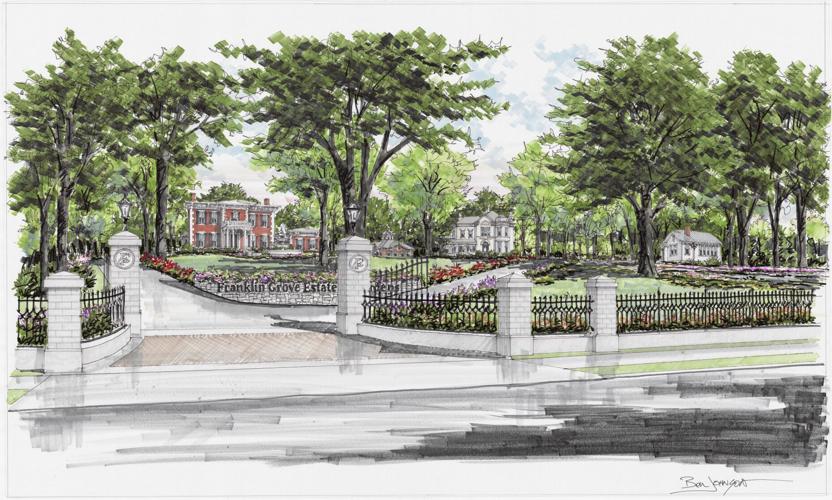
Franklin Grove rendering with Lee-Buckner as the building on the far right
Franklin Grove played an important role in education in Williamson County, not only for the time it housed the Freedmen school. Around 1832, the Hines family opened the Female Seminary of Franklin Grove, which is the namesake of the property today. The seminary closed in 1847 when a larger school for women opened.
In 1866 when the McNutt family returned to the residence, they started a boys school, which closed in 1873. After the house changed ownership several times over the next century, it was eventually bought by Eloise Pitt O’More for her O’More School of Design, which was located in the Winstead House on the neighboring property at the time. This joined the two properties into one as they are today.
With histories of both houses dating back to the Civil War, there are some records of the enslaved people who once worked there. Finch noted after slaves became free there were decades of movement from rural to urban areas with politics playing a part at times.

Franklin Grove with Lee-Buckner on the far right
“In Franklin when you see the historic Natchez district, what is Hard Bargain, the First and Second Avenue South and North neighborhoods surrounded by industry and Lilly Mills, and then even along Columbia Pike today, just south of Ninth Avenue to Folk Street going east, that was Belltown – those were African American communities," Finch said. "But the lines are pretty drawn for where Black neighborhoods were located and white neighborhoods were located."
While Black people were allowed to work in homes in white areas, they weren’t allowed to have property there. That rule wasn’t spoken in hushed tones and known quietly, it was actually written down and clearly stated.
“Interestingly enough [Franklin Grove] at one time was redlined,” Beasley said. “It was written in the deeds; if you were African American, you could not live or rent in this particular area.”
Known as racial real estate clauses, many deeds did have language excluding Black people from buying property. Sometime between the 1930s and 1950s there were duplexes located on the property, which did in fact include those clauses.
“Now, today, we see that as an opportunity to teach segregated history, segregation, meaning through not only education, but also housing,” Finch said. “The power of place is within the ground and moving the school there and putting it where former duplexes once stood that would never have welcomed African Americans to live there, as property owners or renters, to me is a significant story to tell.”
Lee-Buckner serves as a reminder that segregation is not some distant part of Williamson County history. The Heritage Foundation and former students held a panel on the school at the Franklin Theatre, which was built in 1937 and segregated, forcing Black people to sit in the balcony. One of the alumni of the school shared a memory with Beasley who recounted it.
“She said, ‘You know, I had not been in the Franklin Theater since it was segregated. I sat in the balcony, and I watched Gone With the Wind. And I had never been back until I was invited to the stage to be the speaker.’ That was really a profound moment. I think it really is an indicator of still a lot of work to be done, but a lot of good, and I was really taken by her statement,” Beasley said.
Beasley, Finch and the whole Heritage Foundation, along with the students of Lee-Buckner, will now get to move history forward by using the property to teach people about the Black history in Williamson County.
“There's plenty of trials for African Americans following the civil war, but there are also significant triumphs that they made on their own, despite how laws and communities may have attempted to thwart progress,” Finch said.
Beasley said, “How incredible is it that now, in 2024, this schoolhouse that was a beacon of light during a time of segregation will be moved to this historic neighborhood and interpreted, restored and told for generations to come.”

Lee-Buckner students share their stories of education, community


Digging into Duplex, the rural community that created Lee-Buckner