


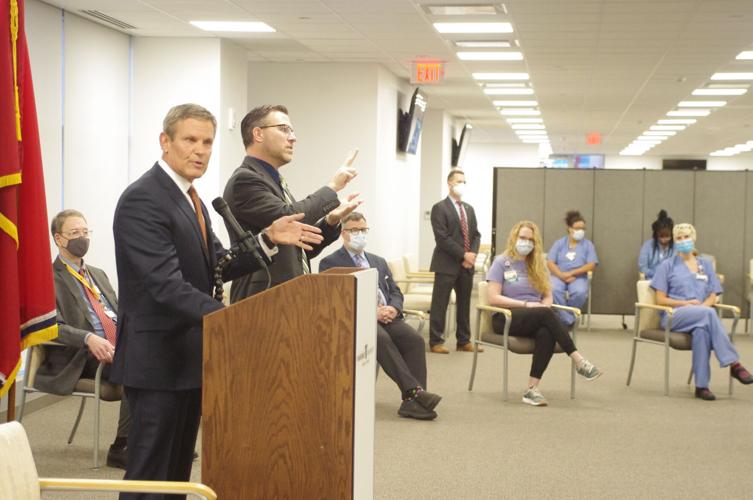


In what was described as a "historic moment" by Gov. Bill Lee, Brentwood resident and Vanderbilt Chief Nursing Officer Robin Steaban administered the first doses of the Pfizer COVID-19 vaccine Thursday morning to a number of frontline healthcare workers.
The arrival of the vaccine comes as cases of the virus continue to surge across the state, with 10,894 new cases reported Wednesday — 325 of which were from Williamson County.

A select few Vanderbilt University Medical Center frontline healthcare workers await their chance to be among the first to receive the Pfizer COVID-19 vaccine.
It was around 9 a.m. that Lee arrived at Vanderbilt University Medical Center Thursday to give a few remarks about what he called a turning point in the ongoing pandemic, while also calling on Tennesseans to "responsibly make decisions that will serve their neighbor."
"It is very true that today's a hopeful day, and we celebrate what is a historic moment and a turning point in this pandemic," Lee said.
"But my message today starts with saying that we cannot look past this sobering reality that we are getting sicker by the day from COVID-19. It's a painful reality, it's harsh... it may even be inconvenient to some, but we have to talk about that today on the day when we are getting vaccines."
Standing adjacent to Lee were a handful of Vanderbilt medical staff who work in the hospital's COVID Intensive Care Unit (ICU). Lee didn't hesitate in championing their resolve, and reminded Tennesseans that the consequences of the virus are lived and seen by those, and all healthcare workers on a daily basis.

Gov. Bill Lee champions the efforts of Vanderbilt University Medical Center staff in caring for Tennesseans suffering from COVID-19.
"I can stand here and say that the direction of COVID-19 in our state is going the wrong direction, but these people have lived it every single day," Lee said.
"They are the ones who see patients gasping in their beds, they're the ones who have watched their patients go on ventilators for weeks at a time, they're the ones who've had to share the news with family members that their loved ones have succumbed to the disease."
Franklin Battle Ground Academy graduate Sophia Whitaker, 32, was third in line to receive the COVID-19 vaccine. Having worked at Vanderbilt for just over two years, Whitaker has worked as a respiratory therapists in the COVID ICU since March.
Before being given the vaccine, Whitaker urged Tennesseans to take the initiative in helping prevent the spread of COVID-19.
"We were the frontline [workers], now residents - people on the streets, civilians — those are the frontline [workers] now, you have to do your part," Whitaker pleaded. "You can keep your bubble small, you can social distance — even from your family. I wear a mask around my grandma at all times, I keep my distance from her as hard as that is."

Vanderbilt Chief Nursing Officer Robin Steaban administers the Pfizer COVID-19 vaccine to COVID ICU Respiratory Therapist Sophia Whitaker.
Given her months of treating COVID-19 patients, Whitaker also cautioned younger and healthier Tennesseans against brushing aside practicing standard safety precautions.
"In the beginning of the pandemic, maybe a month into the COVID-19 ICU's creation, I had a patient just a year older than myself that passed away from COVID-19 that did not have a lot of prior medical history at all," Whitaker said.
"That reality is my every day reality; I've had patients younger than me and around my same age, and to see their lungs completely fail them because of this virus... that could be you. Just because you're young and otherwise healthy does not mean that COVID-19 cannot do that to you."
Receiving her vaccine at precisely 10:37 a.m., Whitaker became among the first healthcare workers in the state to begin the vaccination process.
Steaban, who administered the vaccine, called it a "gift" to be able to help protect her fellow healthcare workers against contracting the virus, many of whom had been treating COVID-19 patients for nearly nine months straight.
"What I think is so important is that many of these people have been in the line of fire since March," Steaban said.
"They voluntarily opened the COVID-19 unit, and so it was such a gift to be able to give them the vaccine today because they have put themselves in harm's way and helped so many people. It was just wonderful to be able to serve them by giving them that protection."

Vanderbilt University Medical Center staff pose for a photo after having received among the state's first doses of the Pfizer vaccine.
Vaccine or not, Steaban called on Tennesseans to continue to do their part in helping stop the spread, recommending limited-sized gatherings, continued mask wearing and social distancing. Furthermore, Steaban advised those who were skeptical of taking the vaccine to be proactive in researching the science behind it for themselves.
"What we've experienced here is a lot of opinions that people get off of social media," Steaban said.
"When we actually put out the science and had town halls for people and really educated them on the science? People changed their minds. So I would say make an informed decision, but make it based on scientific fact and not what's flying around on social media."
While the vaccine certainly marks a turning point in the state's ongoing battle against the virus, Lee closed the news conference with a sobering reminder that in the coming weeks, there is likely to be "a darkness before the dawn."
"We do stand here and celebrate a tremendous breakthrough in this pandemic, but there is a darkness before the dawn that's happening right here in Tennessee," Lee said.
"Tennessee's cases are surging; the holidays have caught up with us. The decisions that some made during Thanksgiving are having a severe reality in this hospital and all across Tennessee today."
In what may be Lee's last pitch to Tennesseans before the holidays, Lee called on residents to think about the impact they could have on their neighbors, their friends and their family.
"One thing that this vaccine will not solve or cure is selfishness or indifference to what's happening to our neighbors around us, this vaccine will not cure foolish decisions about how we gather," Lee said. "[This vaccine] won't cure an attitude of a refusal to wear a mask, and it won't cure the idea that 'I will take my chances' and that that will not impact someone else's life.
"Your decision to wear a mask today may be the decision that keeps you from being treated by these healthcare workers in the weeks ahead. We can and we must turn the tide of COVID-19 in this state, and I need every Tennessean to hear that message loud and clear."
Commented
Sorry, there are no recent results for popular commented articles.