
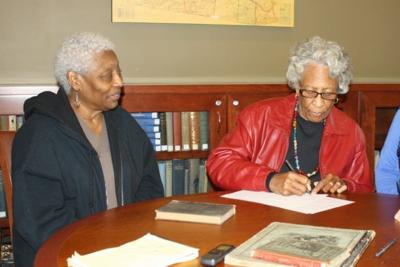
Picture: Mary Ann Murray (left), next to Patricia Scruggs
That their story of growing up black in rural, segregated Williamson County is a happy one for 80-year-old cousins Mary Ann Murray and Patricia Scruggs speaks to the healing power of family in tough times.
The story of their great-great grandparents Henry and Lucretia Holt getting married and starting that same family while surviving the Civil War and gaining their freedom sounds happy, too, for the same reasons.
But it was a tale the cousins, whose roots the African American Heritage Society of Williamson County picked to unearth this year as its pioneer family, waited nearly 80 years to tell.
Sitting around a table in the the Williamson County Public Library’s Special Projects Room, Murray and Scruggs spent the morning Thursday hearing the Holt’s story with African American Heritage Society of Williamson County historic committee co-chairs Christina Jones and Paulette Johnson, who over the past year rediscovered the early chapters to Murray’s and Scruggs’ family story.
“It is exciting, very exciting,” Scruggs said.
“I never thought about it, and when my father was still living we didn’t ever ask. But in the last few years it has seemed more important to try to figure out,” Murray said.
Jones’ and Johnson’s findings will be presented at the AAHS 16th Annual Black Tie Affair on Saturday, Feb. 4 at 7 p.m. at the Embassy Suites in Cool Springs. Each year the AAHS tells the story of a pioneer family– meaning one whose roots can be definitively traced back in Williamson County to before 1850.
The story this year starts with Lucretia Holt.
She was born likely in 1833 on a 1,200-acre plantation named first Holt’s or Holtland and later, in a typical example of the Old South’s romantic and grandiose aesthetic, Wildwood.

Both were the property of Thomas and his wife Julia Herbert Holt, wealthy Louisiana cotton planters.
“While it is impossible to know for sure, we believe that Lucretia would have been one of the four girls under 10 years of age listed on Thomas Holt’s 1840 slave schedule,” Jones said. Finding records for individual slaves before the 1860 is extremely difficult, Jones explained, because prior to that slaves, as property, were not counted. One of the only sources of information today for research are slave schedules, taken every 10 years as a rough inventory of plantation owners, with slaves not listed individually until 1860, and then not by name, under the household of their owner.
The Thomas Holts in 1840 owned four girls under 10 and two women between 10 and 24, one of whom Jones believes would have been Lucretia’s mother.
The next evidence of her comes from the 1850 slave schedule. It lists two 16 to 18 year-old girls owned by Holt at Wildwood, one of whom Jones believes to be the then 17-year-old Lucretia.
The next decade was an eventful one for her.

“Around 1855, when she was 21 years old, we believe that she married her husband, Henry Holt, who would have also been owned by Thomas Holt,” Jones said.
Henry, the researchers found, was born in Florida, and sold at some point to the Holts, who may have had connections in that state.
“They would have had a traditional, or slave, wedding and probably would have been married by an African American preacher, but there would be no documentation or license,” Jones said.
The newlyweds quickly began a family, and would have three daughters then a son by the end of the Civil War. Tennessee, the first daughter, was born sometime in 1855.
The 1860 slave schedule, the first to list slaves individually though still not by name, gave information that paints clearer picture of Lucretia, but also raises new questions.
“At that point for the first time we find out she is what was called mulatto, bi-racial, which is interesting,” Jones said. “I wonder who her father was.”
Jones added that she would love to get testing done on Murray’s and Scruggs’ DNA for genetic heritage.
A second daughter, Eliza Ann Parrish came in 1860, then Henrietta in 1861 and William “Willie” M. Holt in 1865.
Willie, Murray’s and Scruggs’ direct descendent, would have been born at the end of a three-to-four year stretch of tumult. The Civil War wrecked Nashville and Williamson County; chaos and uncertainty reigned, with the freedom of more than half of the county’s population in question as control between the sides was not yet settled.
“It is impossible to know what Lucretia and her family did during this time,” Jones said. Many of the 12,000 slaves living in Williamson County before the war left their plantations for so-called contraband camps set up near Union Fort Negley in Nashville and Fort Granger in Franklin.
“We do know that by 1870 they are back to – or perhaps never left – Brentwood,” Jones said.
The first free-born member of Lucretia and Henry’s family, and their last known child, Margaret, was born four months before the 1870 U.S. Census. This was the first time across the country that slaves were counted as people rather than property.
Records show that the Henry Holt family still lived in District 16 in Brentwood – where the Holt plantation had been and was still owned by Thomas and his wife – in 1870. The family was still living in there in the 1880 U.S. Census as well.
By then Lucretia and Henry were 47 years old, with Willie, 13, and Margaret, 10, still at home. W.H. Edmundson, their grandson, 8, was also living with them, likely Tennessee’s son. Tennessee disappears from the record after 1870, it is the researchers’ educated guess that she died in childbirth.
Throughout the Reconstruction period, it appears that the Holts were sharecroppers, likely renting land on their former plantation from their former owners to farm and live on.
After 1880, however, there are no records of Lucretia or Henry.
“We don’t know when they died; no death certificates or graves have been found,” Jone said.
The trail goes somewhat cold in 1890, because the U.S. Census of that year was lost to fire in Washington, D.C. Jones said the loss is a formidable obstacle to re-creating the ancestry of former slaves.
Through the 1930s, the report states that in Brentwood it was common knowledge the black families living on the Holtland plantation descended from former slaves there.
Willie, the only son of the Holts, is the person to whom Murray and Scruggs are directly related. His life overlapped with them by two years. He went to school, married Elizabeth Winstead and he managed Tom Primm farm. They had five children. At the age of 74, Willie died in 1939.
One of those children, Maggie Lou Holt, born in 1880, married John Patton. They had 15 children; two of the sons became Murray and Scruggs’ parents.
Murray and Scruggs grew up together, near the Holt property, going to school in a one-room schoolhouse, before Scruggs’ father moved her family to Franklin.
Both women grew up, got married and continued the story that came back to the beginning this with with the new-found family history.
Scruggs’ great-granddaughter was born a few years ago. Her name, picked before knowing her whole story, is Lycretia.
“But she is named after Hank Williams wife’s daughter,” Scruggs said, with a laugh.
It might be a coincidence, but it is a reminder that even as lives comes and goes family never dies.
Commented
Sorry, there are no recent results for popular commented articles.