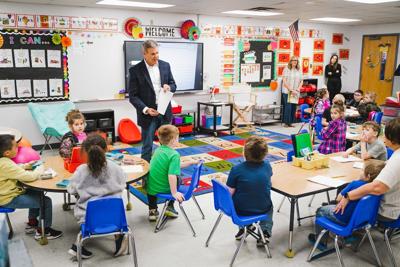
Last school year, more Tennessee families sent their children to kindergarten unvaccinated with a religious exemption than had in recent memory.
Kindergarteners are required to receive a series of shots by the time they enter a public school, per requirements from the Tennessee Department of Health.
The Tennessee Department of Health has published its Kindergarten Immunization Compliance Assessment Report annually since at least 2013, according to spokesperson Dean Flener. There is a push for the Metropolitan Board of Health to begin collecting immunization records for child care centers, too, as evidenced by a resolution to be considered by the Metro Council on Tuesday.
The state health department measures each county against an ideal threshold of 95 percent of kindergarteners vaccinated. Davidson County falls short of the threshold, at 92.5 percent of students fully immunized. Davidson County also clocks in short of the statewide average of 93.3 percent of kindergarteners vaccinated. The report shows the second straight year of decline in immunization coverage statewide.
“TDH has chosen a 95 percent threshold as an ideal immunization goal because this is the percentage of the population that would need to be vaccinated against a highly infectious disease (such as measles) to ensure protection for the entire population, including those who are unable to be vaccinated because of their age or due to other reasons,” said Flener.
Statewide trends show a sizable decrease in kindergarten vaccinations in the past two school years. In the 2020-21 school year, the state reported that 72 of Tennessee’s 95 counties met the 95 percent fully immunized threshold. The next year, that had decreased to 43 counties. In 2022-23, only 26 counties met the 95 percent threshold.
“I think this vaccine hesitancy that people are perceiving as just happened or is increasing because of COVID probably already existed,” said Kerri-Ann Anderson, Vanderbilt University researcher and graduate student. “It's just that that was a crisis or some trigger for people to start thinking about vaccinations all over again — reevaluating their values, why they vaccinate, what they actually think about vaccines.”
The public schools with the lowest vaccination rates in Davidson County were Hattie Cotton STEM Magnet Elementary School with a 79.4 percent vaccination rate and Jones Paideia Elementary Magnet School at 75 percent. Napier Elementary School and John B. Whitsitt Elementary School boasted 100 percent vaccination rates, with Glendale Elementary School and Hull-Jackson Elementary School reaching 98.6 percent.
Of the students who were not fully immunized in Davidson County, the largest group had religious exemptions, followed by temporary immunization certificates, incomplete records and missing records, with the smallest group filing medical exemptions.
Statewide, the public school religious exemption jumped from 2.2 percent to 2.9 percent between the 2021-22 and 2022-23 assessments. Private schools saw an even more significant jump in religious exemptions, up from 2.2 percent to 5 percent year-over-year. Private schools were less likely to submit immunization data, however, with only 73 percent of those asked participating compared to 96 percent of public schools. In the 2020-21 school year, 1.8 percent of students used a religious exemption statewide.
A religious exemption is relatively easy to obtain in Tennessee — it requires a signed statement by a parent or guardian stating that the vaccination conflicts with the family’s religious tenets. However, students entering into Metro Nashville Public Schools must have a health examination, and the health care provider must note the religious exemption.
Researchers at Vanderbilt University have found that vaccine hesitancy is nothing new, but there are a few key factors — including community influence and low barriers to exemption — driving vaccination decisions today.
Anderson told the Post that beliefs are not fully predictive of behaviors when it comes to vaccination.
“If a vaccine has strict exemptions, for example if there are no exemptions besides medical, you’re definitely going to see an increase in vaccine outcomes,” she said. “Vaccine confidence or hesitancy may not change. People may still hold on to their same beliefs, but behaviors might change.”
She noted that parents might also sign the religious exemption to save time, because they do not have easy access to take their child to get vaccinated.
Co-researcher Nicole Creanza, assistant professor of biological sciences, said that when it comes to vaccine decisions, people are influenced by the opinions of those around them, whether in favor of or opposition to vaccination In addition, modern technology allows people to consume opinions from those with whom they might not physically interact, and those opinions hold weight especially if they perceive that individual to be important or educated. Misinformation can thrive this way, Creanza said.
“I think easy access to accurate information — making it so that verifiable and scientifically rigorous information is really easy to find — it’s not a cure-all, because if people want to find other information, they can seek it out and find it,” she said.
Commented
Sorry, there are no recent results for popular commented articles.