

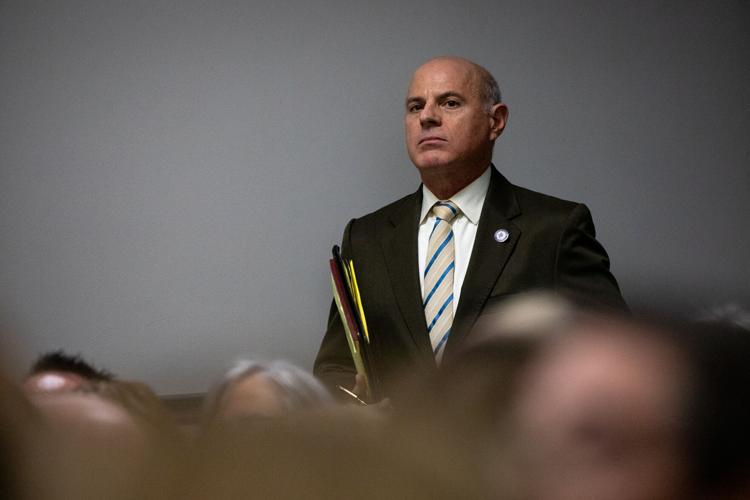



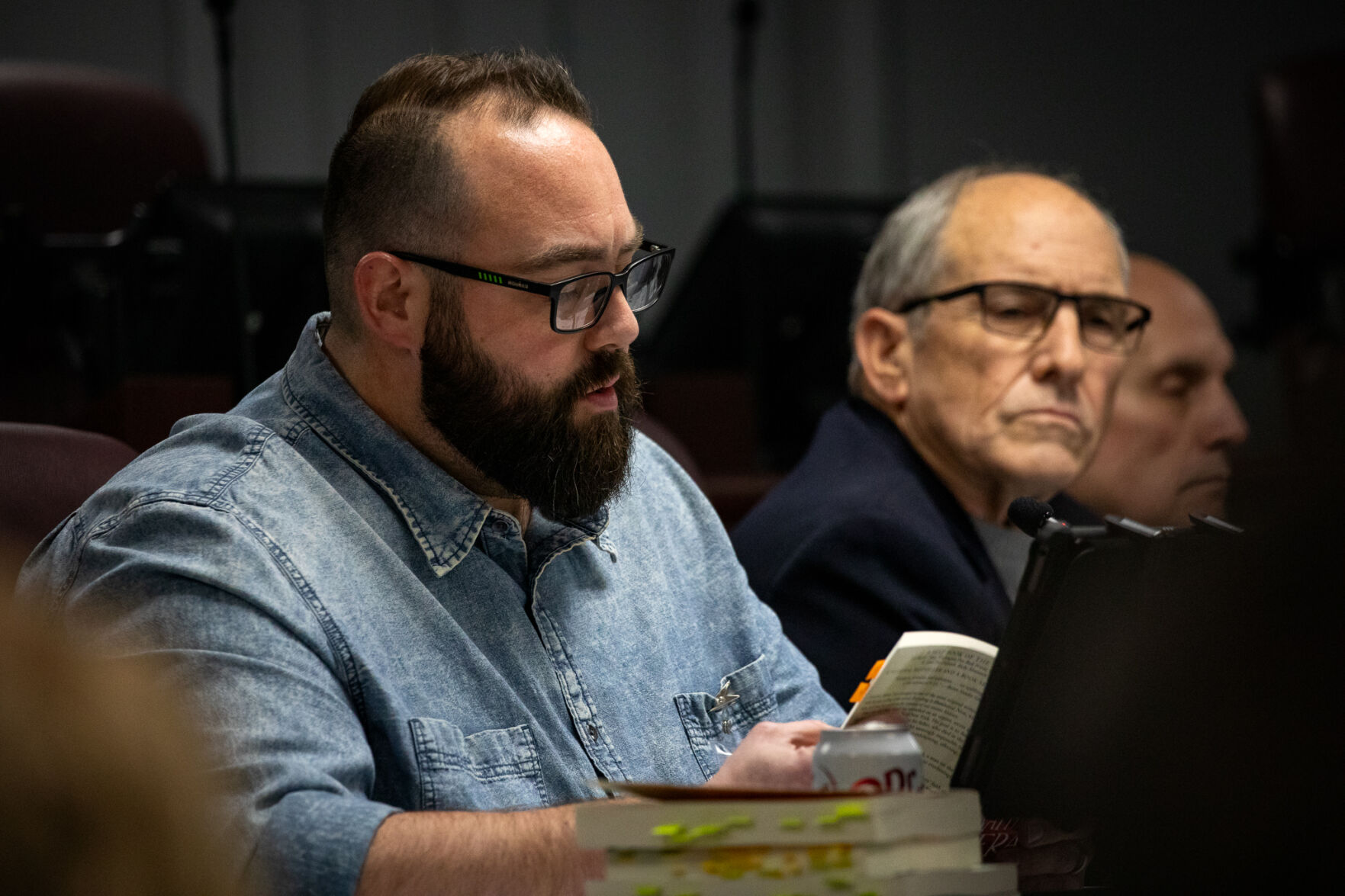
Williamson County Schools Board Member Tony Bostic reads aloud a passage from 'Extremely Loud and Incredibly Close' during the Dec. 9, 2024, WCS Board meeting.
The Williamson County Board of Education voted to remove three books from its school libraries and restricted access to two other titles during Monday’s special called meeting.
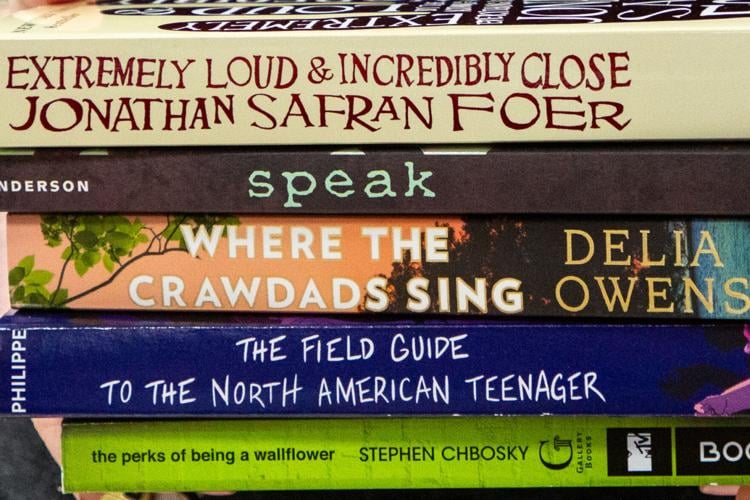
The 1999 novel The Perks of Being a Wallflower, 2005 novel Extremely Loud and Incredibly Close and 2018 novel Where the Crawdads Sing were effectively banned from all Williamson County schools after a majority vote on each title.
The board also restricted access for the 1999 novel Speak to high school students, while the 2019 novel The Field Guide to the North American Teenager was restricted to high school juniors and seniors. Speak was previously present in both WCS middle and high schools while the four others were previously only in high schools.
All five of those books have received major motion picture adaptations since their individual literary releases. Where the Crawdads Sing was one of the nearly 400 books that were banned from nearby Wilson County Schools in October.
All board members were present for the meeting with District 6 Board Member Jay Galbreath attending remotely via Zoom.
The votes broke down in several different ways for each book. Extremely Loud and Incredibly Close was removed in a 9-3 vote, with Eric Welch, Melissa Wyatt and Galbreath voting no. The Field Guide to the North American Teenager was restricted to high school juniors and seniors in a 10-2 vote, with Welch and Wyatt voting no. Speak was restricted to high school students in an 8-4 vote, with Welch, Wyatt, Dan Cash and Drason Beasley voting no. The Perks of Being a Wallflower and Where the Crawdads Sing were each removed in a 10-2 vote, with Welch and Wyatt voting no.
A WCS spokesperson told the Williamson Scene that the removal of the three books from schools has already begun, although it’s unclear at this time how many copies of each book are in the schools. The two now restricted books will be removed from school library shelves and “students will need to work with their school’s librarian to check out the book[s].”
Ongoing litigation
In June 2023, the board, which saw half its members change after the August 2024 election, discussed the five books and voted to retain the challenged books after complaints originated at Ravenwood and Franklin High Schools.

District 61 Rep. Gino Bulso, who represented parents in a 2023 lawsuit against Williamson County Schools regarding 'obscene' books, attends the Dec. 9, 2024, WCS Board meeting where the board removed three books from school libraries.
The books were then the subject of a 2023 lawsuit against the school which was filed by Brentwood attorney and District 61 State Rep. Gino Bulso for parents and several unidentified plaintiffs who alleged that the books are “obscene materials” and that the school system allegedly violated the Age-Appropriate Materials Act of 2022.
That bill was sponsored in the senate by Sen. Majority Leader Jack Johnson (R-Franklin) before it was signed into law by Gov. Bill Lee in 2022.
In 2024, the state legislature passed a revised version of the act which specified that “material that contains nudity or descriptions or depictions of sexual excitement, sexual conduct, excess violence, or sadomasochistic abuse for the age or maturity level of a student in any of the grades K-12 and must not be maintained in a school's library collection; or is patently offensive, or appeals to the prurient interest for the age or maturity level of a student in any of the grades K-12 and must not be maintained in a school's library collection.”
In October, Williamson County Circuit Judge Deana Hood ordered that the school board take up the matter. Bulso called the ruling a “huge win for Williamson County parents and students.”
The school board was tasked by the judge with determining if the books were “appropriate for the age and maturity levels of the students who may access the books” and if the books were “consistent with the educational mission of Williamson County Schools.” That mission states: “We exist to provide all students with a quality education that supports their intellectual, physical, emotional, and social development.”
In the June 2023 meeting, the board approved keeping the books based on the recommendations of two committees but didn’t make a determination about if the books were appropriate and consistent with the mission, which led to the lawsuit and the ruling.
Williamson County attorney Lisa Carson said at Monday’s meeting, “While the court’s order relates to the state law, board members must also be mindful of federal constitutional law, which allows you to make decisions regarding which materials are appropriate for the educational environment and which materials are appropriate for specific age levels, but limits your discretion to remove materials based solely on viewpoint or ideology.”
Carson added that she has “expressed a concern that the law as applied could run afoul of the Constitution.”
Board meeting discussion
The board made its decision based in part on recommendations from WCS librarians, who previously determined that the books were appropriate for students, and the board members' own assessment of how to comply with state law.

A citizen holds a sign in protest of the removal of books from school libraries during the Dec. 9, 2024, Williamson County Schools Board meeting.
The three hour long meeting saw more than 50 people in attendance and public comments were issued from 25 people, including some current WCS teachers and several representatives of the Williamson County Chapter of Moms For Liberty. Fourteen comments made at the meeting were in favor of removing the books from schools.
Some of the public comments in regards to keeping the books in schools characterized the texts as “lifelines” for some vulnerable students. Advocates for removing the books likened the titles as “graphic” and “obscene” with multiple people arguing that the books were not being banned and would still be accessible to the general public outside of the school system.
One public commenter spoke about her own experience being sexually assaulted in fifth grade and later finding solace in reading Speak in eighth grade, telling the board that, “limiting students’ access to books that address complex issues does not protect them from those experiences … While these books may not be for everyone, for the kids who need a window or a mirror, they are everything.”
One of the members leading the push for removal was Tony Bostic, who was one of six new board members sworn into office in September.
Bostic was one of several members who brought in copies of the books with dozens of pages marked with multicolored sticky notes and read aloud passages from the texts to illustrate their arguments for or against the titles.
“I think the board voted to apply the law as written and remove the books that needed to be removed under that law,” Bostic told the Williamson Scene following the meeting.
“Parents do not want us to take away these reading options for their children, a small group should not eliminate options for our entire community, the subjects discussed are happening in our world and community,” Melissa Wyatt, District 7 board member, said.
Many board members made their comments about all the books at the beginning of the meeting during the discussion of the first book Extremely Loud and Incredibly Close. The Perks of Being a Wallflower, the oldest and one of the most well known titles on the list, saw no discussion before its removal from school libraries.
One librarian who reviewed the titles said that Where the Crawdads Sing is “appropriate” for high school students and noted that the book had been chosen as the favorite book among Ravenwood High School students in March 2023, which was less than a year after the movie adaptation was released. However, the board found that the book did reflect some sexual themes detailed in the Age-Appropriate Materials Act.
Bostic read a passage from the book detailing a sexual encounter of one of the characters and added, “I have no doubt that Where the Crawdads Sing was voted as a favorite for pubescent teens in school, that’s not shocking to me,” he said, followed by some laughter from the audience. “You have to ask yourself, is the position of a school one of education and protection or is the position of the school one of exposure to things that are offensive or explicit? I would argue that it’s to educate and protect children, not to expose them to sexual themes.”
WCS Board Chair Josh Brown said that while Where the Crawdads Sing “of all the five, probably has the most literary value and probably the most important story to tell, but again, because we’re bound by the state law, it’s pretty clear to me that at least section 2E and probably section 2D are violated by multiple passages in this book … In spite of how good the book may be, and there certainly is a lot about the book that’s very important and good, and all the ratings would verify that, unfortunately, we’re bound by the state law and I think there’s too many explicit instances of violations of that law.”
Eric Welch, one of the longest serving members who represents District 10, was the most vocal opponent of the removal and restrictions of any titles, giving an impassioned speech while discussing Speak, which was the most discussed book during the meeting though it was the least restricted of the five books.
Board members Margie Johnson (D5) and Donna Clements (D8) argued that children reading about serious subject matters such as rape could be “triggering.”
Clements was one of several board members to bring up the idea of advanced parental approval or “opting in” for some books. Parents can already opt their children out of accessing library books.
“This is a very heavy topic and I know that we can’t tonight put this on a parental approval list, but knowing just what data tells us about sexual assault and what even young children are exposed to, it would be really pertinent for parents to have knowledge that their child is reading a book about rape and date rape,” Clements said.
According to the Rape, Abuse and Incest National Network (RAINN), the nation's largest anti-sexual violence organization, each year, more than 430,000 Americans 12-years-old and older are sexually assaulted or raped, and some 60,000 children are victims of “substantiated” or “indicated” sexual abuse, with the majority of that abuse of children occurring between ages 12-17.

Williamson County Schools Board Member Eric Welch (left) listens to concerns from a citizen who supports removing books from schools during the Dec. 9, 2024, WCS Board meeting.
“I wish that wasn't the world we lived in. I wish we didn't need books like Speak. I really wish we didn’t but the reality is we live in this world,” Welch said. He also read aloud passages from the book and emails from several WCS graduates and sexual abuse survivors.
“I had a bad experience with a boy my age who took advantage of me without my full consent,” one of the emails recounted. “After months of keeping it to myself and fighting this intense depression, I finally told my parents. My mom later gifted me the book Speak about a girl in high school who was sexually assaulted and learned to speak up. This book means a lot to me and still does. It made me feel less alone and validated my experience. When I saw it was being banned, all I could do is feel the injustice for the girls who need to be encouraged to speak up about these things, these real things.”
“No man has ever raped a woman because of this book, but we just might stop a date rape because of it,” Welch said, calling the book “very supportive of the educational mission.”
Following the meeting, Welch told the Williamson Scene that he was disappointed in the outcome and called it a “victory for censorship.” He also expressed concern that the board could continue to remove more books from schools and take more time and resources from the board.
“The amount of labor and focus and everything that we’ve put on banning books in school library at the cost of things that actually impact students – What I’ve found are things that actually garner the most visibility and attention, tend not to be the things that have the largest impact on student performance, which is what we’re supposed to be here for,” Welch said.
According to WCS library data provided to the Williamson Scene after the publication of this story, the five books only saw a total of 24 checkouts throughout the entire WCS school system during the previous 2023-2024 school year.
In that school year, The Field Guide to the North American Teenager was checked out once, from FHS; Extremely Loud and Incredibly Close was also only checked out once from Brentwood High School.
The Perks of Being a Wallflower was checked out 7 times, once from Nolensville High School, three times from FHS and three times from RHS. Where the Crawdads Sing was checked out 6 times, once from BHS, once from RHS and four times from FHS.
Speak was checked out 9 times, three times from Sunset Middle School, three times from Woodland Middle School, once from RHS, once from FHS and once from Fairview High School.
The most read book of the five since 2021 is Where the Crawdads Sing because there were more reads over the year that the film was released. In the 2021-2022 and 2022-2023 school years, it was checked out 21 and 14 times respectively.
Aiden O'Neill contributed to this report.
Editor's note: The Williamson Scene has clarified that Eric Welch is one of the longest serving board members. He was the first elected of the group but lost one term before returning to the board.
Commented
Sorry, there are no recent results for popular commented articles.