


If Love on the Spectrum star Tanner Smith encounters a police officer, he knows what to say.
“I’d tell them that I need a little more time because I have autism, and I need patience,” Tanner Smith told Williamson Scene. “Sometimes it takes me a minute to understand words.”
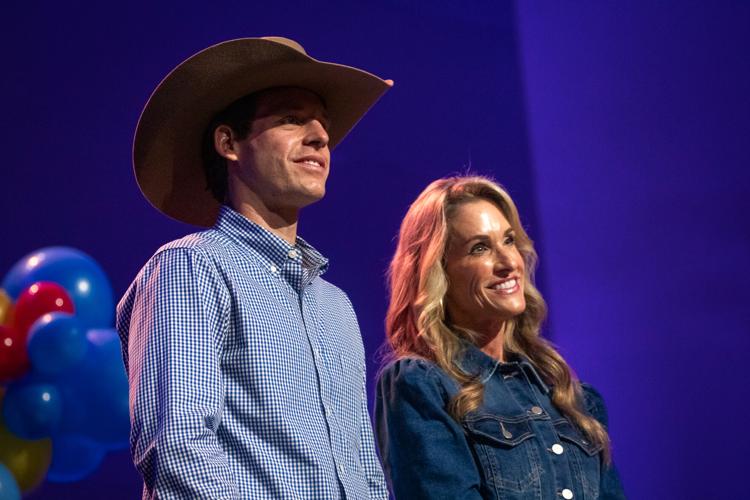
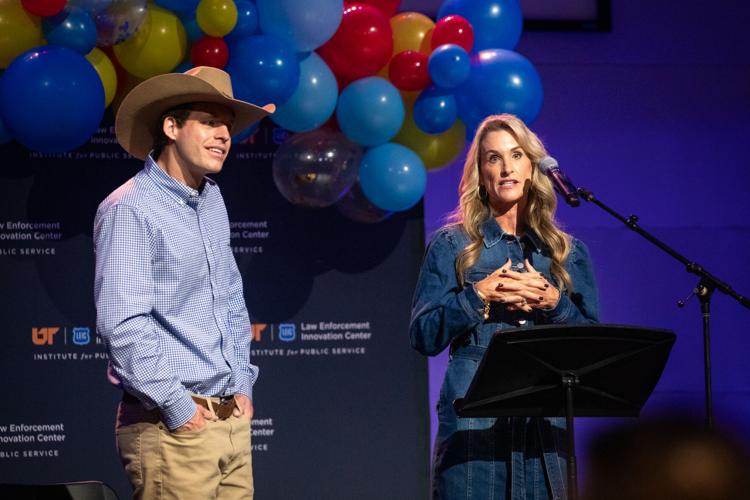
The always-smiling Tanner Smith, clad in boots and a hat he had been given at CMA Fest earlier this year, spoke to more than 100 law enforcement officers from across the state in Franklin last week. He was joined by his mother Nicci Smith. The Effective Policing: Autism Response conference was presented by the University of Tennessee’s Law Enforcement Innovation Center at The Church at West Franklin.
The conference was the first of its kind from the center, says Jeff Hundley, training specialist at UT Law Enforcement Innovation Center. Law enforcement is often called in when people with autism are showing violent behaviors or running away. The typical training tactics of using a commanding voice, lights and loud sirens can trigger people with autism and make matters worse, he says.

Tanner and Nicci Smith answer audience questions at the Effective Policing: Autism Response conference in Franklin
“I've been saying for this conference that Tanner was here to humanize autism for officers, but in turn, him being here with officers is going to humanize law enforcement for those that are autistic,” Hundley tells the Williamson Scene.
It was the first such speaking engagement for Nicci and Tanner Smith following the rise of Love on the Spectrum on Netflix. After their talk, nearly the entire audience lined up for a photo with Tanner Smith, and he greeted each person by name.
The show is about more than just love, Nicci Smith points out — it shows humanity in people with autism and makes the condition interesting to the average person. She was pleased to learn that many of the officers at the conference were people who had children with autism. When it comes to interactions with law enforcement officers — and Nicci Smith says her son’s have been positive thus far — Tanner Smith has learned to advocate for himself as best he can.
“Say, ‘I don’t understand. Can you repeat that? Can you help me? I don’t know what you mean,’” Nicci Smith explains. “That sounds very simple, but it's huge, because things can be misinterpreted as being defiant or ignoring or not cooperating when they really just don’t understand.”

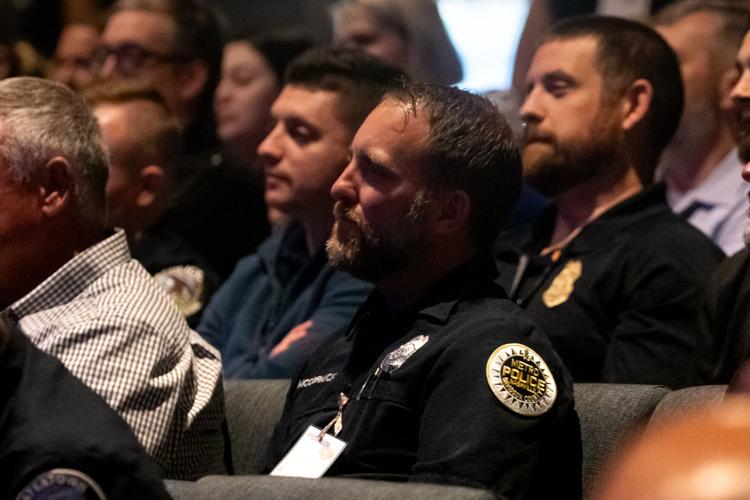
Law enforcement officers listen to keynote speakers at Effective Policing: Autism Response conference in Franklin
For Brooke Tanner, development director at The Arc Williamson County and mother of three autistic sons, the family motto had always been “don’t call the police” when her eldest had a violent outburst.
She had heard horror stories from other families about their children being taken away or even facing charges for neglect. In April, police in Idaho shot and killed a teen with autism, which prompted advocates to speak out about police understanding of autism.
Even during her session, Brooke Tanner says many other local mothers of kids with autism still avoid the police at all costs. Things changed when she forged a friendship with Officer Dillon Lipinski, a major crimes unit detective at Franklin Police Department, who also has a child on the autism spectrum. Lipinski has a relationship with her kids now, and she even contacts him directly when there is a problem.
At last week’s conference Lipinski held two sessions on responding to missing persons with autism. He highlighted the importance of talking to family members to learn more about an autistic person’s tendencies. He also emphasized the importance of searching near bodies of water and in enclosed areas that people with autism may be attracted to — they are also more likely to drown than neurotypical people.
“Everybody has a loved one that's on the spectrum, knows somebody who has one on the spectrum," Lipinski says. "They need us, and they need us to be able to respond to these calls proficiently. I think that for some reason, autism has fallen as a lesser priority on things. We focus on the tactics. We focus on active shooter stuff. We focus on all of it, which is equally important. We need to know how to do all of that too, but we can avoid a lot of things if we know what we're doing when it comes to responding to people with autism as well.”
Brooke Tanner hopes more parents will consider reaching out to form a relationship with area officers, and discussed in her session low-barrier opportunities for officers to do that in their community.

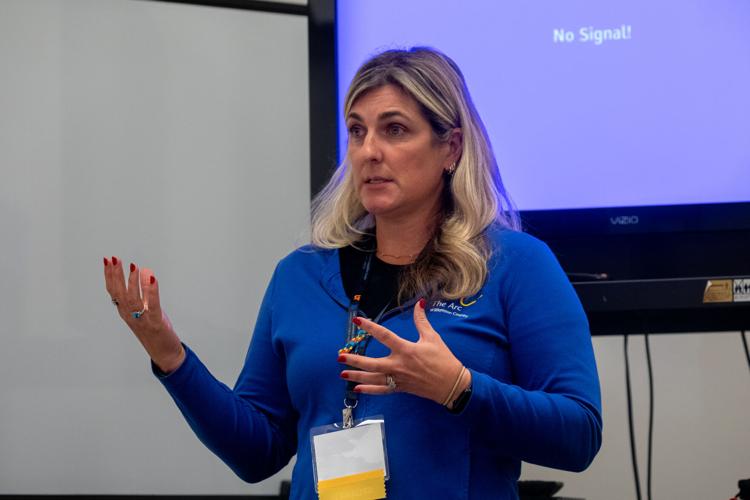
Brooke Tanner, development director at The Arc Williamson County and mother of three autistic sons, shares insights with law enforcement officers at a Franklin conference.
“We just need to be available when [police] do seek us out to show that I'm willing to work with you in this, and I'm not so afraid that you're going to take me away or take away my child,” Brooke Tanner says.
It’s a good start, but the outcome of any 911 call is not guaranteed. Seeing officers from across the state come to the training on their own accord was encouraging, she says.
“It’s been such a beautiful thing to see,” Brooke Tanner says.
Tanner Smith wanted to see what it feels like to be handcuffed. One of the officers obliged.
“Look, mom!” he exclaimed as his mother took a photo. She joked that he was being arrested for being too nice and bringing too much joy.
“We know I’m not really getting arrested because I’m not a burglar, a crook or a thief,” he later told the Williamson Scene.