
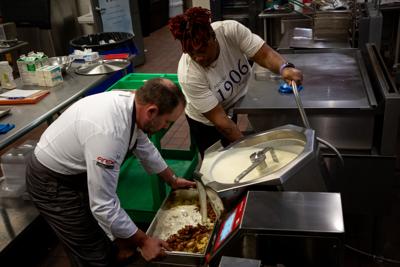

Franklin Special School District is leaning into kitchen technology to help make school cafeterias more efficient, with fresh food more common for its students.
This year, the district became the first district in Tennessee to begin using the Firex Cucimix automated multi-purpose industrial cooker, which is an automated electric tilting braising pan that can cook (and stir) fresh foods such as sauces and soups.
“We’re hoping that this machine will allow us to increase the quality of our food and increase the items that we prepare from scratch,” FSD Food and Culinary Services Supervisor Robbin Cross told the Williamson Scene. “They follow the recipe that we have, and they prep the goods and turn on the machine. Then the machine will beep and tell him when it's ready to add something.”
The equipment is normally found in large-scale commercial restaurants and dining facilities. It can be programmed to make (and stir and prevent burning) everything from bolognese, marinara and alfredo sauces, homemade soups and fresh beans, macaroni and cheese and more.
“You get consistent products, consistent cooks, allowing it to be a little bit easier for quality scratch cooking, getting away from processed foods for our younger generation, giving them the nutrients and energy that they need to get through their day. So better food, healthier kids,” said Chef Chris Fersch, Firex/Southbend Regional vice president of Culinary and Consultant Services during an Aug. 25 demonstration at Freedom Middle School.
In 2020, FSD became one of five school systems selected as a recipient of the Chef Ann Foundation Get Schools Cooking Grant, a three-year grant that helped transition schools to “scratch cooking,” and its participation in the U.S Department of Agriculture’s Healthy Meals Incentives for Schools.
The district has 34 food and culinary department staff members who regularly feed around 2,000 students now with more fresh-roasted vegetables, grass-fed beef hamburgers, and even mixing their own taco and lemon pepper seasonings.
“This allows us to cut down the sodium, and it cuts out the preservatives and additives that are added to a commercial prepared seasoning blend,” Cross said.
This latest kitchen equipment was funded by a grant, this time from the U.S. Food and Drug Administration, with FSD planning to continue to pursue grants to fund educational opportunities in a world of rising costs for labor and goods and rapidly changing technologies.
“We spent close to $800,000 on new equipment last year and in researching what's out there to help us make the journey to scratch cooking,” Cross said. “It's been used in a number of restaurants, but we were the first ones in Tennessee to use it in schools, and we have one at each of our [eight] schools.”
“You're looking at the future, and this is the future in a lot of restaurants and a lot of restaurant systems,” said Chef Danny Cerqueda, director of culinary for the Hanson Group.
“By utilizing something like this, they're [school cafeteria staff] able to advance their skills in the kitchen, so that we're able to put together some recipes, and it makes it easier for them to do multiple things to create large quantities of food, with just the touch of a button.”