
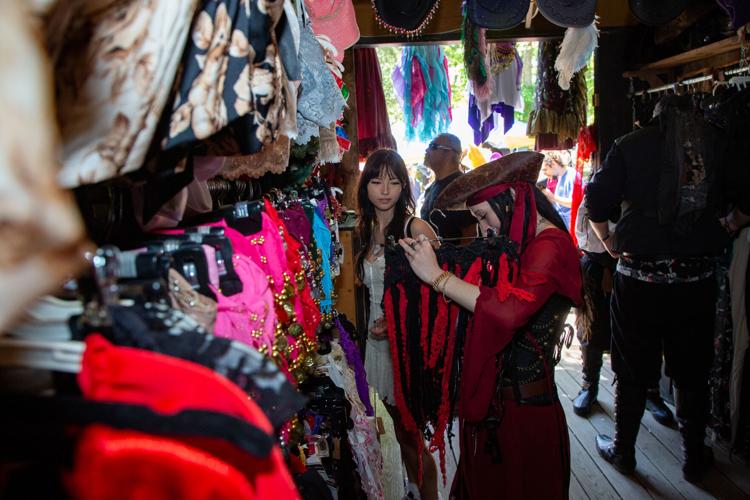
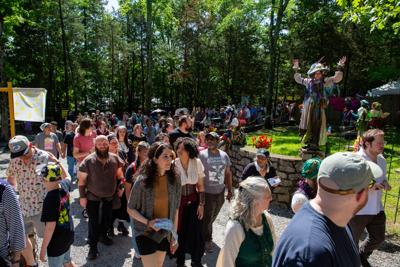
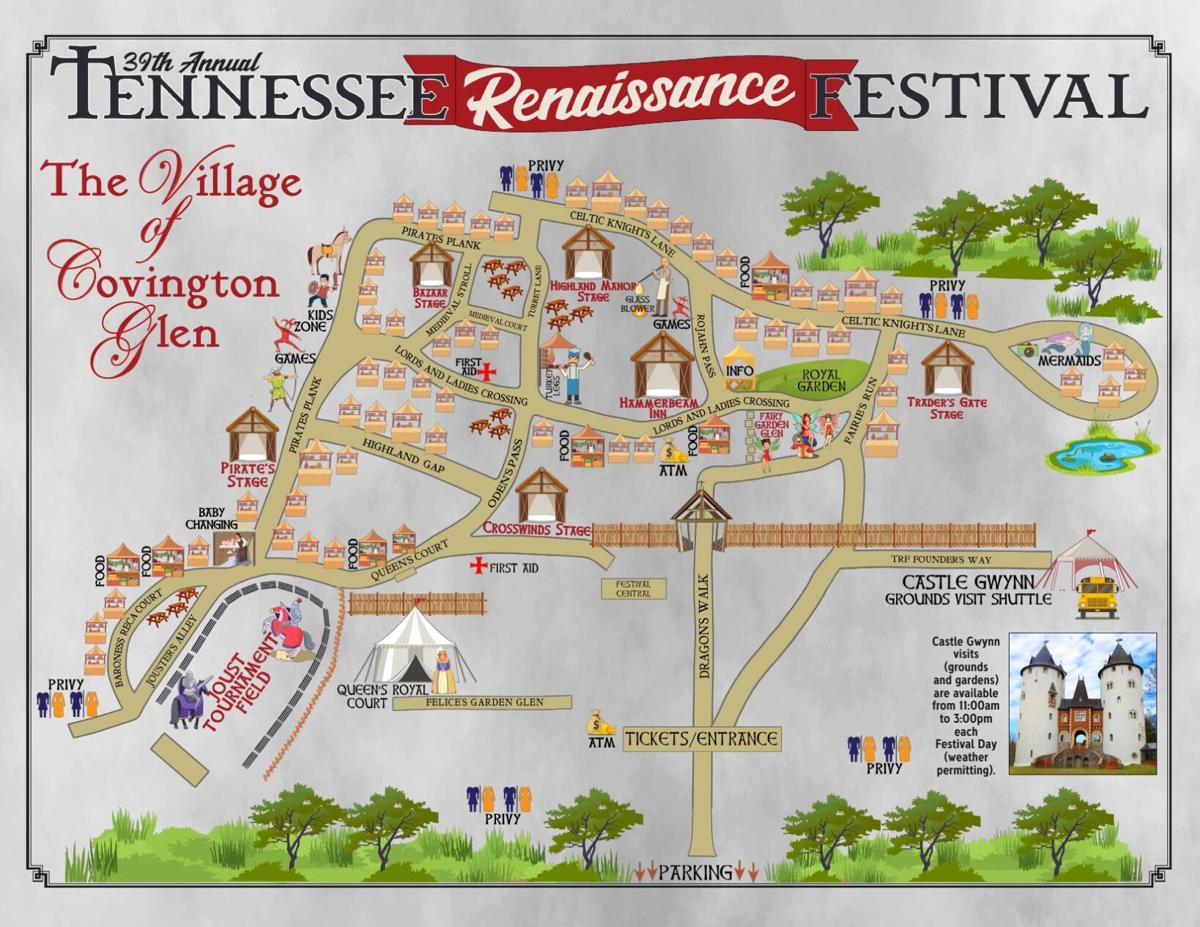
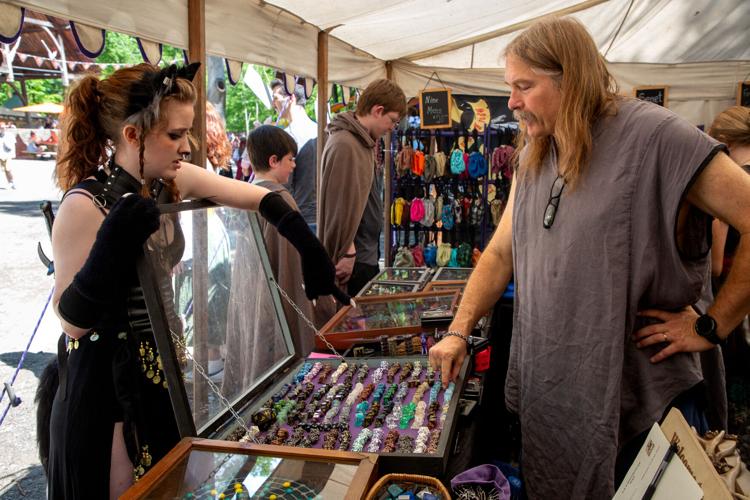
Down Lords and Ladies Crossing, through Highland Gap and Rojahn Pass, Gothic letters are painted on wooden signs hanging above the entryways to tents and small wooden shops. Merchants in long dresses, tunics and robes stand behind tables full of everything from longswords and daggers to handmade leather bags, jewelry and worn leather books made to look like ancient spell tomes. Some merchants call out in Middle English dialects to passersby.
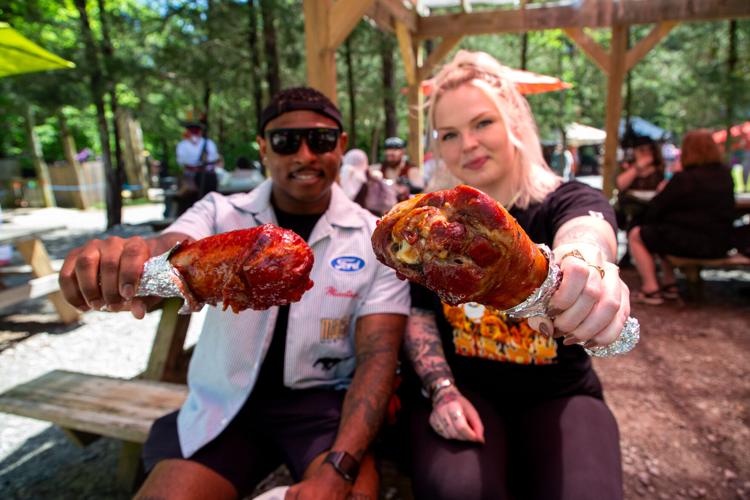
Fortune tellers sit inside dark canvassed huts filled with crystals, trinkets and bowls full of chicken bones. There are hair braiding and face painting booths. At target ranges, a man dressed like Robin Hood teaches a little girl the proper technique for drawing and firing a bow. Food stands throughout the park offer charred corn-on-the-cob, funnel cakes and turkey legs that large enough to be used as weapons.
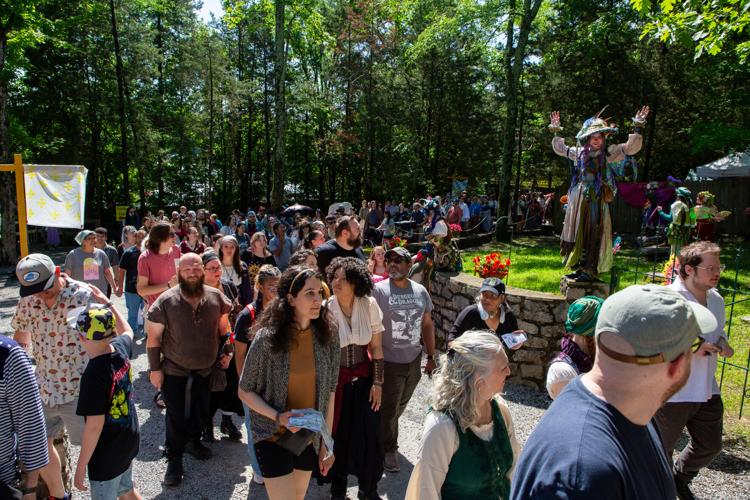
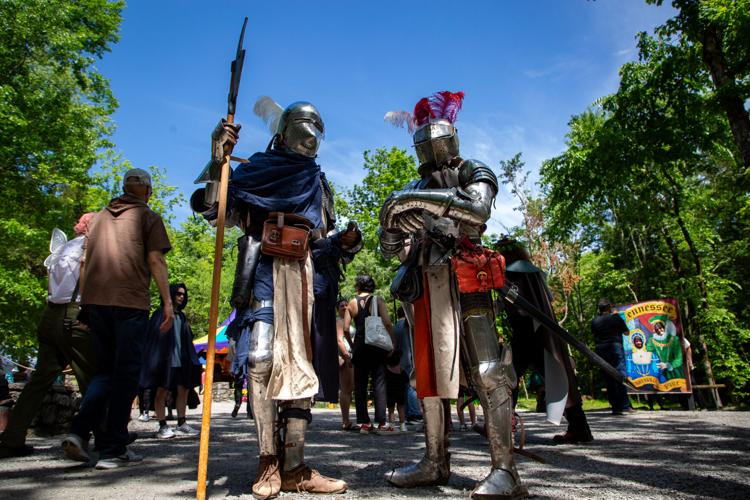
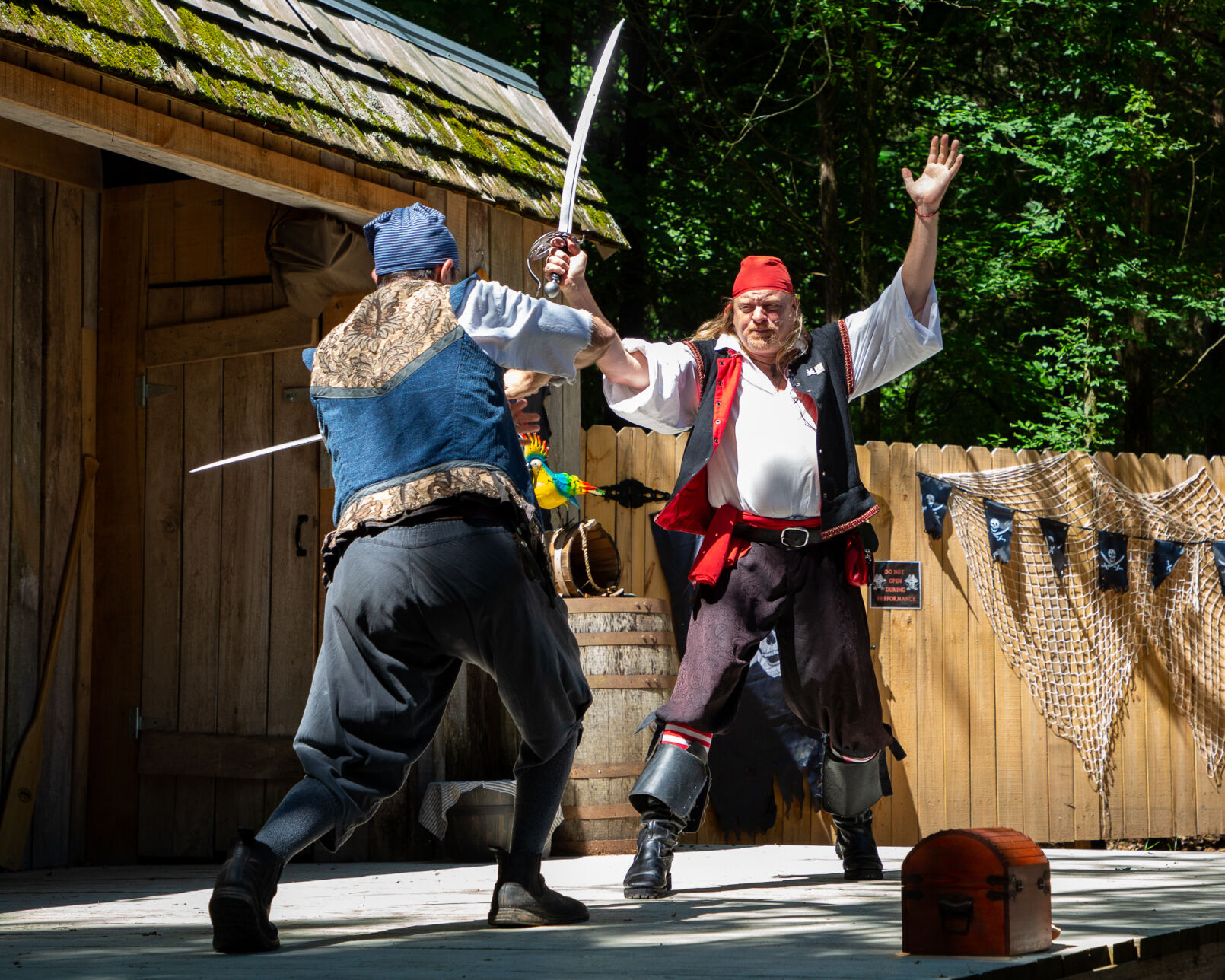
If one were to stand just outside the Hammerbeam Inn — a stone-and-wood pavilion near the entrance to the festival, where most of the foot traffic takes place — they would encounter a medieval gumbo of characters: vikings, fairies, mermaids, pirates, kings and queens and werewolf-knights. There are men dressed in full metal plate armor and chainmail dresses toting steel blades, and children dressed like tiny green dragons, holding their parents’ hands as they trot down the gravel paths of Castle Park.
It has been a common scene in the Williamson County park since 1986. Every weekend in May, the quiet, wooded area near Arrington is transformed into a village market of the Middle Ages.
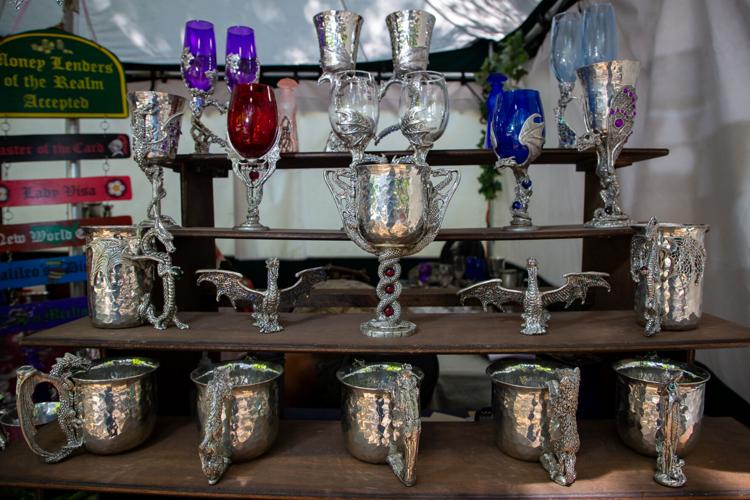
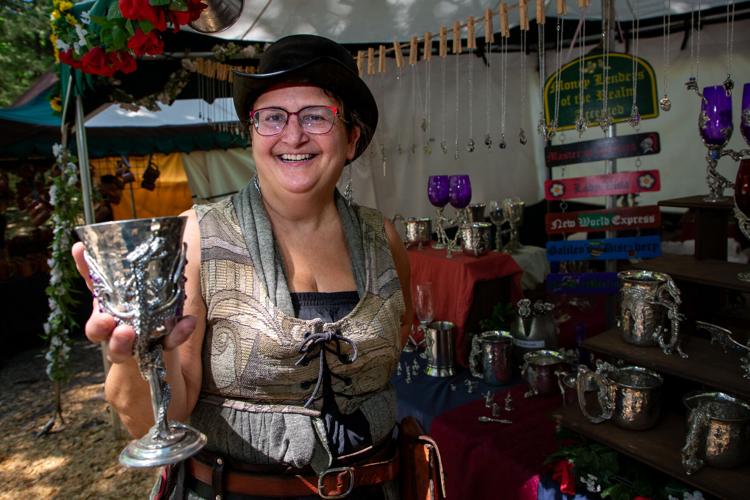
Near the Western end of Celtic Knights Lane is Bethany Coslar. In front of her is a table full of pewter goblets and mugs, with handles carved in elaborate and whimsical designs. One mug’s handle is designed to look like a cat, standing on its hind legs, peering into the basin; the stem of another goblet features an incredibly-detailed dragon, clutching a purple crystal in its claws as it stands atop a mountain of writhing, twisted smaller dragons.

Coslar comes across as a saleswoman by nature. She points out the various details of her pewter goblets, mugs and trinkets. She speaks enthusiastically, as if she had never seen the items before — as if she were a customer, standing on the other side of the table, marveling at the pewter designs alongside you.
Coslar has been working at Renaissance festivals across the country for more than 30 years. Her interest began in Colorado, where as a teenager, she had hitchhiked from Maryland as part of what she called her “rebellious” phase. Eventually, she found a job in a Russian Café, where one day, a friend approached her with an invitation.
“We’re going to war,” Coslar recounted her friend saying.
Coslar and her friend attended the war, and watched people dressed in plate armor and chain mail thrust padded maces and wooden swords at once another in large scale, mostly-safe battles.

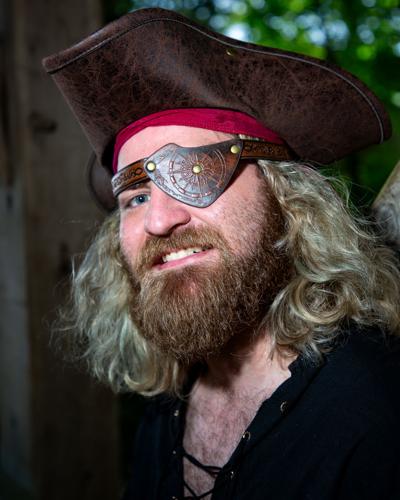
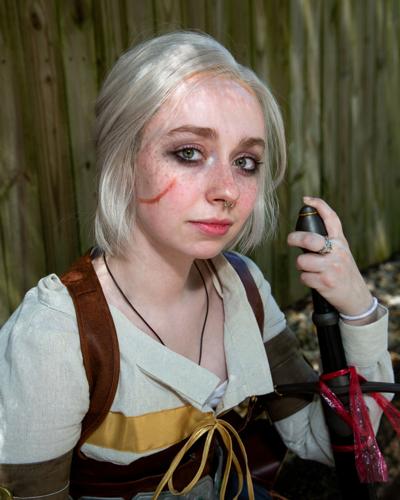
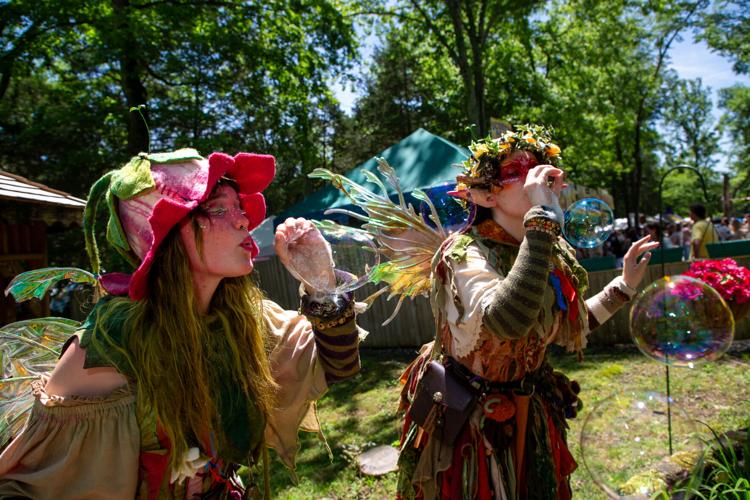
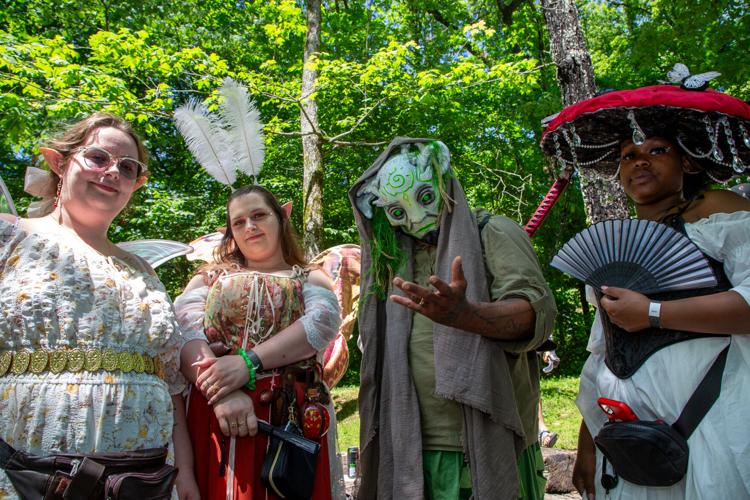
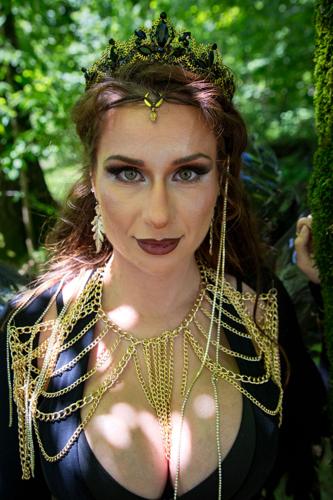
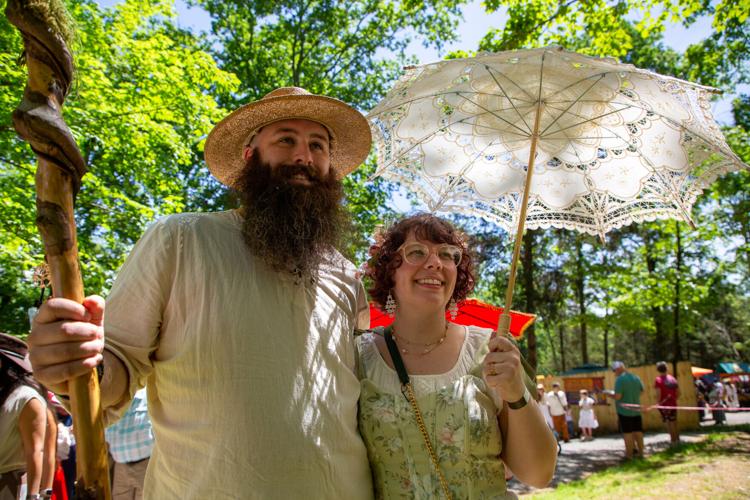


2025 Tennessee Renaissance Festival
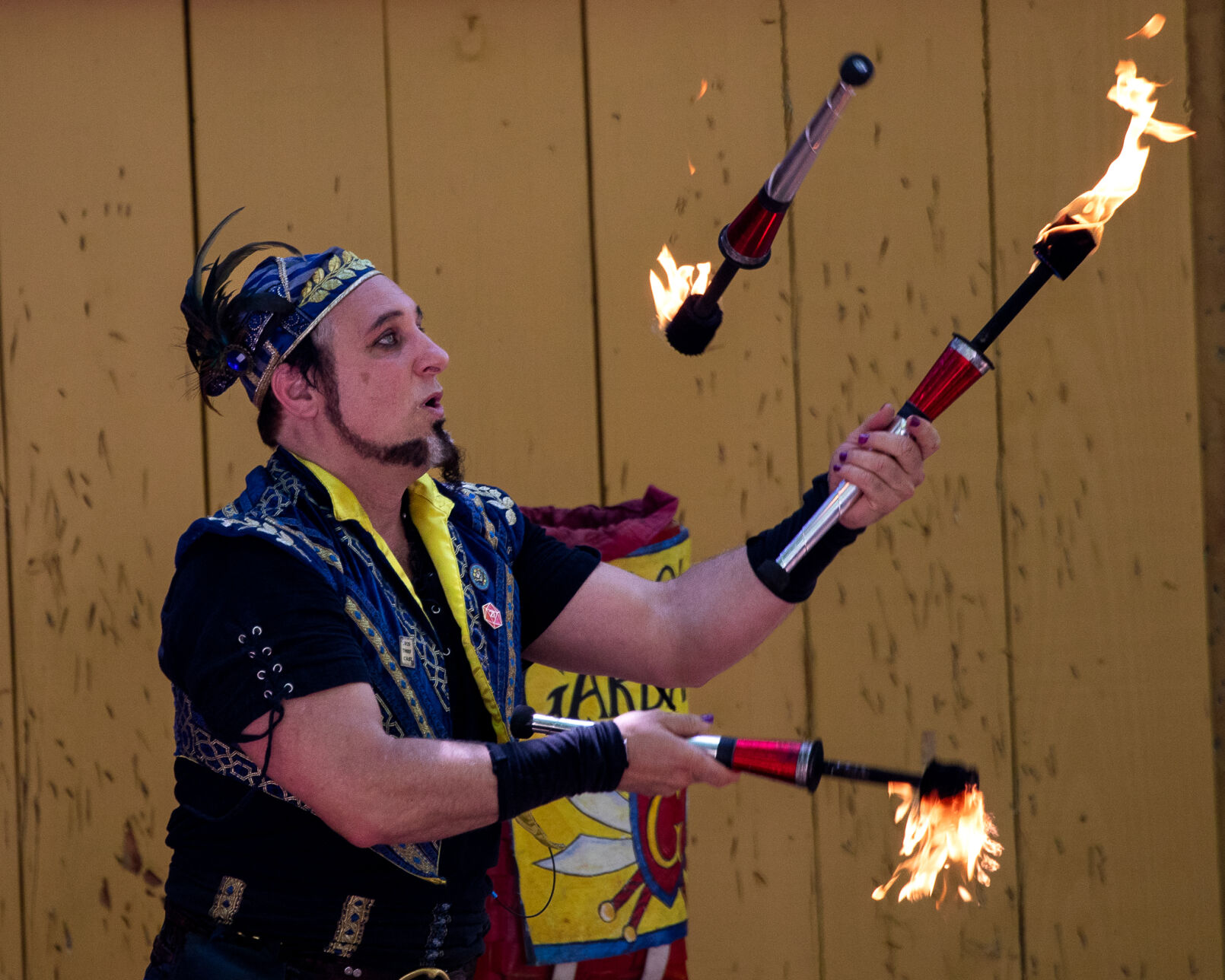
A couple months later, Coslar showed up a bus stop in Los Angeles with five dollars in her pocket, following up on a job offer she had received from a couple who made chain mail.
A few years later, Coslar would begin working for her current employer, Fellowship Foundry Pewtersmiths, where she sold products at Renaissance Fairs across the United States.
Coslar spent seven years working at Renaissance fairs full-time. When she got pregnant with her son, Josh, she transitioned to a job in banking to pay the bills. She worked in banking for 30 years, working at the festivals part time on the weekends to continue pursuing something which she had fallen in love with.

These days, Coslar is back to full time employment with Fellowship and Foundry. For the last two years, she has had a full schedule of shows. After the Tennessee Renaissance Fair, she’ll head to Georgia, then to Colorado, New York, Texas and Oakland. By then, it will be Christmastime, and she will have a short break before starting over again next February.
Whether you sell pewter or soft pretzels, full-time employees of Renaissance fairs must be able to move constantly from place to place. They may be sleeping for four to eight weeks at a time in tents or in their booths; or if they’re lucky, in lodging provided by the festival.
“We're trying to give people an experience outside their norm. And so, for that reason, there's extra steps to vending,” said Rhonni DuBose, who has spent years working at Renaissance fairs across the country. Now, in what she terms her “semi-retirement,” she provides consulting services to vendors seeking to navigate the complicated processes of managing a business that is constantly moving from place to place.
“I think it's worth it 100 percent. Because, I joke that there's no complaint department where I work, because people have the intention of having a good time before they buy a ticket,” said DuBose. “And so with that, you're already dealing with people that are ready to be in a jovial mode.”
Food vendors will often have to travel to upcoming festivals weeks in advance, says DuBose, in order to prepare booths for serving food — and that may include fixing water lines or removing cobwebs and birds’ nests which may have spawned during the off-months.

To make festival vending a full-time career, sacrifices may have to be made. Sometimes, that includes relationships with friends and family. Certain people are only ever seen a few days out of the year, and as a result, some relationships are unable to withstand infrequent visits.
But then, there are others which, because they do withstand time and distance, are realized as evidently special.
“It teaches you that friendship isn't finite,” said Coslar. “It teaches you that friendship doesn't have to be restricted or controlled. You either love them or you don't. And if you do, then however you get them is how you get them. And that that is the biggest lesson of driving around the country and running into people or not running into people around the world, to me, anyway.”
The lifestyle requires skilled labor on top of sacrifices — whether that be salesmanship or practical skills, such as carpentry or glasswork. Many trades take years to perfect — whether it be ironworking, leather-tanning, or sword making. And even then, after years of learning all the nuances to a particular skill or trade, there is certainly no guarantee of wealth.
“Your experiences are important,” said Coslar. “If you only want to make money doing retail, you can go to a mall if you want to support yourself, because. ... you're not going to see large amounts of money. ... The life you live is the important part — how you live is the important part.”
There can be anywhere from 40 to 400 of these vendors and employees at every festival, depending on the size. And, for the most part, they are bound by common interests — in the community, the atmosphere and the fantastical experiences imparted by the events. Or, they enjoy a job that takes them around the United States. Or, maybe, they are just looking for a group of people they want to fit in with.
“I mean, there's just all sorts of reasons to cling to it,” said Coslar. “I'm in it for the community, the avant-garde approach and feeling like I belong. I don't know how many people in your generation say, 'I feel like an alien,' but I did my whole life.”
Coslar recounts a time before she decided to work at Renaissance fairs, before she had left her hometown to hitchhike across the country, when her father asked her what it was she wanted to do with her life.
“He said, ‘What is your goal? What do you want? You're so impractical. What do you want?’ And I said, ‘Well, Dad, I want to meet, shake hands with and talk to as many interesting people as I can before I die,” said Coslar.
“And I think that I am living up to that.”