

“I don’t know why you do this, do you?” says Marty Lang in his New York accent, tracing a U-shape in the air with his foil.
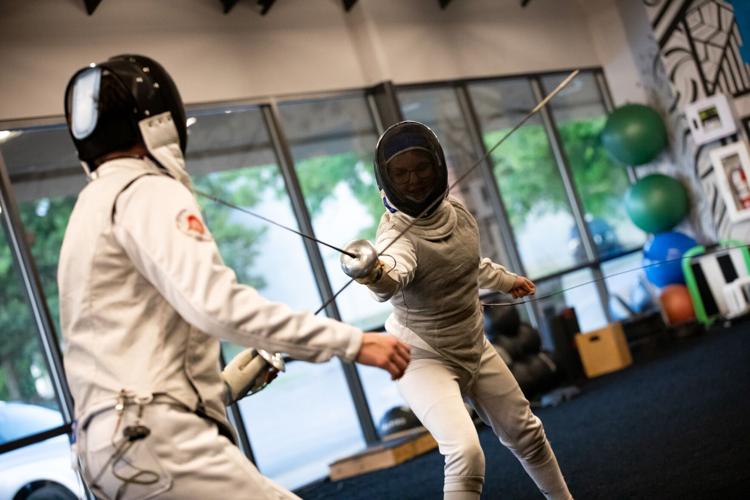
The founder of Lang Fencing Academy in Brentwood is preparing his student, Campbell Lahman, for a national competition. They’re practicing a move called a parry, a flick of the wrist that deflects an opponent’s attack. He’s encouraging her to “be ferocious.”
“I am loud when I teach because I want them to know when they do it right,” Lang tells Williamson Scene. “I want them to know when they do it wrong.”
Lang, a former Olympian and 2024 inductee to the USA Fencing Hall of Fame, has 50 years of experience under his belt.
“It takes me one minute to watch what you're doing, and I can critique you, and I can work with you. I have a pretty good eye in that way,” he says.
On Tuesdays and Wednesdays at a gym in Brentwood, students aged from 12 to 80 years old practice together. For the first time this year, he also hosted classes through Williamson County Parks and Recreation.
Lang insists that the smartest person usually wins the match — often regardless of age and nimbleness. An often-used phrase in the fencing world is “chess with the body” because both games require that one anticipates the movements of their opponent. In tournaments, fencers earn ratings A through E based on their skill level.
Lang’s sole focus is foil, which uses a light, flexible sword with a button on the end. Depress that button into the opponent's torso covered in a silver material, and get a point, or a “touch.” Achieve five touches to win the bout.
Lang has probably explained this thousands of times in his career, but his passion for the sport hasn’t waned.
“I’m an enthusiastic guy,” he says.
Scoring is digital, with a cord run through the sleeve of the lamés or uniform and plugged into the foil, or sword. A light and a buzzer communicate who got the touch. The cords are necessary — it all happens so fast — but Lang’s students are also trained in officiating.

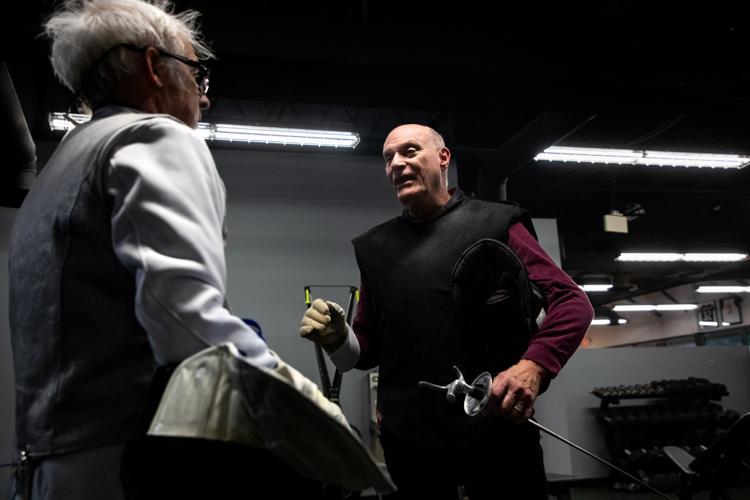
Marty Lang talks to a fencing student at a class. He is the founder of Lang Fencing Academy.
“It's helpful to officiate a match when you're a fencer yourself, because it helps you learn the rules,” says Campbell Lahman, a club fencer at Western Kentucky University. “But even though we're all fencers ourselves, we still have a hard time doing it, because you see the light, but then you have to talk through everything that happens and sometimes it’s not obvious.”
At one time, Lang taught a larger group five nights per week, but some graduated and younger people never replaced them, he says.
“I have fenced all over the world. Now, the people who are here, I want them to get to the level they want to,” Lang says. “Everyone has a different idea.”
Stephen Burt has driven in for lessons from Thompson's Station for the past few years. A search about fencing (the yard kind) brought up fencing the sport. It’s as close as you’ll get to a light saber, he thinks.
“This is the same kind of skill, but you don’t have light sabers,” Burt says. “It’s a good individual sport, so you’re not holding the team down by being the weak link and sitting on the bench.”
He adds, “I'll listen to whatever he tells me to do fencing-wise to get better, because he knows what he's talking about.” If Burt is a padawan in training, Lang is certainly Master Yoda.
Lahman first learned about fencing through her father, Richard Lahman, another of Lang’s students.
“He’s kind of a big deal, and he’s here in Brentwood,” Richard says of Lang. “He has a lot to offer.”
Lang started fencing for his high school team, and lost just five bouts during his time at New York University. He trained under Giorgio Santelli, founder of Salle Santelli, an esteemed fencing salon known for training up U.S. Olympians. Lang left the sport and worked for 30 years in hospitality before returning in the early 2000s.
The public may know of fencing through the "Zoro" movies, or a scene in "The Parent Trap" or by watching the summer Olympics next year. Lang says there are already athletes in the sport who deserve to be household names, like Lee Kiefer, four-time Olympian and three-time gold medalist who trains in Kentucky.
Most of Lang’s students are recreational, but he can turn up the intensity for a more serious competitor, even one who wishes to reach the Olympics like he did in 1976, he says.
“Everyone here is different,” Lang says. “Everyone is different. Everyone has a different physical makeup. Everyone has a different mental makeup. But one thing is most people are nice. I’m not going to have people in this club that aren’t nice.”