
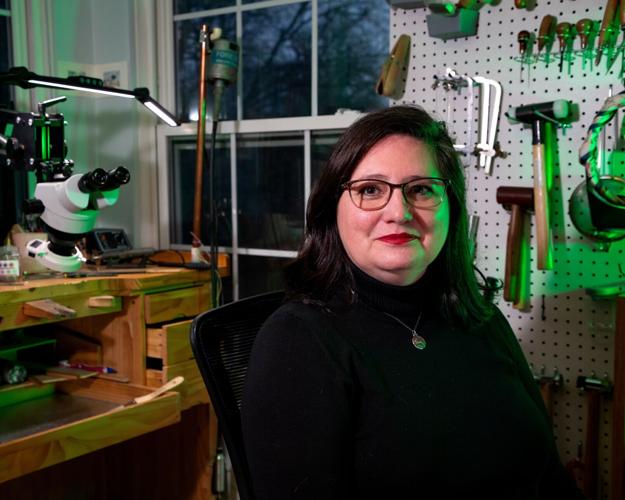
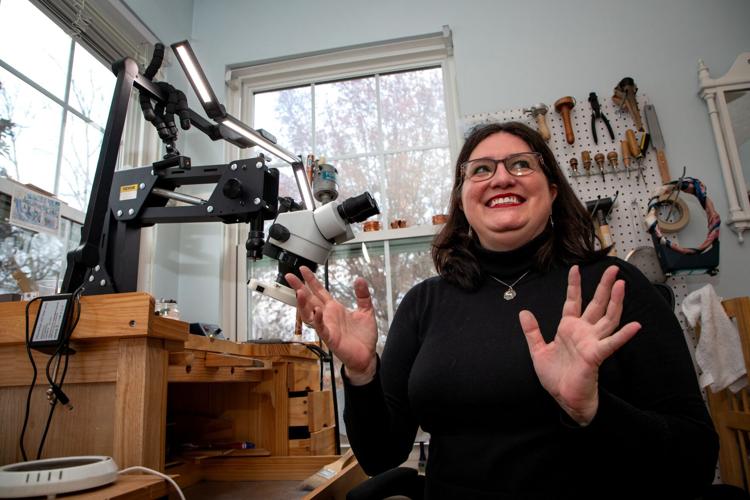

Montealegre Atelier is the perfect name to encompass local artist Valerie Michelle Wilhite Ramírez’s work. Montealegre is her grandmother’s maiden name. “Monte” means mountain in Spanish, and “allegre” means happy or joyful.
Ramírez’s mom is from the country of Colombia, and her dad was from Appalachian Tennessee.
“Being from the Appalachian Mountains on my dad's side and the Andes on my mom's side is kind of how I think of myself, as being that person that loves greenery and vegetation and mountains,” Wilhite Ramírez tells the Williamson Scene.
The impetus for Wilhite Ramírez to begin making jewelry was her love for medieval literature and art. She earned a doctor of philosophy degree in comparative literature and medieval studies and was teaching as an assistant professor of modern languages at the University of the Virgin Islands, hoping to strike up conversations.
“There's nobody to talk medieval literature with on an island in the Caribbean,” Wilhite Ramírez says. “I started making jewelry using medieval manuscripts. I thought, I'm gonna make something that is me, and use it to promote ‘hey, the Middle Ages are interesting.’”
She’s passionate about the study of humanities, believing it forces people to take time to think about what it is to be human. It has the power to quell prejudice and prevent people from repeating abhorrent history, she says.

When a hurricane decimated the university in the Virgin Islands while she sheltered with her aunt in Colombia, Wilhite Ramírez simply decided to pivot entirely. She began jewelry school in Colombia, where silver, gold and emerald mines are plentiful.
Her goal was to create her own business using local resources to make beautiful jewelry that she’d sell online all over the world.
Wilhite Ramírez’s well-respected and “berraca” or “kick-ass” aunt suggested she work for a business before starting her own. Wilhite Ramírez was a bit homesick, so two years ago, she returned to spend time with her mother in her hometown of Franklin and work at a jewelry repair store. At home, she found community in other artists.
“Now I am really interested in joining these communities, because it's something I didn't have in the middle of nowhere in Colombia, and I was really isolated and lonely,” she says. “I'm really enjoying being able to meet with other people who have a lot of the same concerns. And it is really neat to think I'm an artist.”
Artist is an identity she’s always wanted, but worked to accept.
“I didn't think of myself as an artist. I thought of myself as a jeweler,” she says.

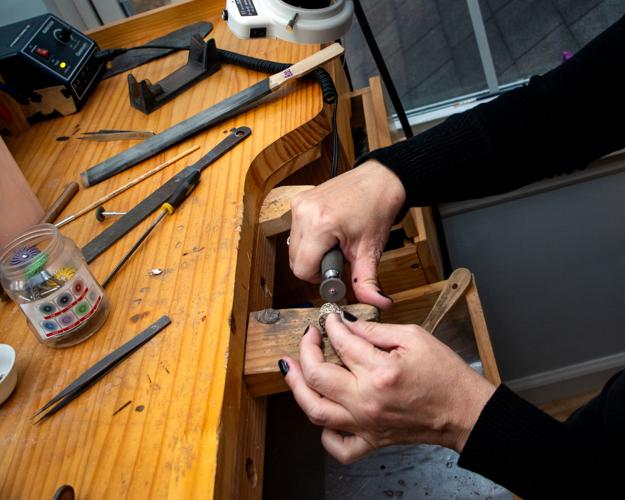
Valerie Ramírez polishes one of her pieces ahead of the December 2025 Franklin Art Crawl.
Once, a ceramicist at an art show in Colombia referred to the two of them as “we the artists.”
“I remember that day, in that moment, feeling like I'm an artist,” she says. “I felt so special. That just filled me with googly, googly feelings.”
The Periscope program within the Arts and Business Council of Greater Nashville, which teaches artists how to become entrepreneurs and live off their art, further cemented her path.
Working in silver can be a challenge, let alone white or yellow gold. Today, a small piece of silver is $52, which would have been $20 four years ago, she notes. However, Wilhite Ramírez is staying the course, and selling her art during the December art crawl and beyond.
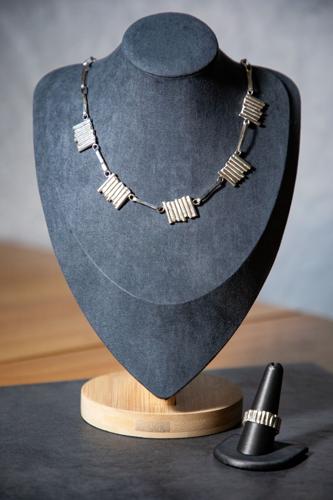
What many may find tedious, she finds satisfying. She heats, pulls and cools wires over and over to make them extremely thin, before twisting three pieces together and forming them into intricate swirls called caracoles (snail in Spanish). The use of the filigree wire, called filigrana momposina, is a Colombian tradition. She also uses two different types of casting to create shapes inspired by her love for medieval architecture — One based on a Gothic medieval cathedral building is a standout. Then there are several rounds of polishing, using various sanding grits and polishing wheels.
“It’s peaceful, it’s meditative, it’s calming. I love it,” she says.
The result is a piece that will last a lifetime, with historic inspiration behind it that former professor Wilhite Ramírez is keen to share.